Universities, Consultancies, and Chatbots: Where AI Is Forcing the Next Trade-offs
Murilo (00:07)
Hi everyone, welcome to the Monkey Patching Podcast, where we go bananas about all things balding, ads, and more. My name is Marilo, I'm joined by my friend Bart. Hey Bart. How was your weekend, Bart?
Bart (00:15)
Hey, Marilla.
⁓ I had a chill weekend actually. Didn't do much. weather also wasn't great. So it was a good weekend to chill out.
Murilo (00:23)
Okay, that's nice. weekend. Okay.
Yeah,
feel like you start to see, we saw a bit of sun last weekend, at least here, ⁓ but it's colder, like also in December, so I guess it makes sense.
Bart (00:38)
Yeah, it
actually dried out a little bit on Sunday and I went inline skating.
Murilo (00:43)
⁓ well, inline skating, like, what's that?
Bart (00:46)
⁓ Well, you skate with inline skates. I don't know. You go on the road and you put on a pair of inline skates and then you skate.
Murilo (00:55)
And what's the difference between inline skates and inline skates? ok, inline skates. Yeah, yeah, yeah, yeah, yeah, yeah. Ok. So roller skates is like the ones that like two in front and two in back on each feet. And then this one is all like...
Bart (00:59)
The wheels are in a line as opposed to roller skates where you have two pairs.
Yeah, exactly. ⁓ Which you need to do in
a disco or something.
Murilo (01:13)
Yeah, yeah, see we don't want to have like the little break on the front like the little butt. Okay, yeah, yeah. And then rollerskates, me push here, is it. In light skates, this is it.
Bart (01:17)
Yeah, yeah, exactly, exactly, yeah.
Yeah, yeah, something like mine look a little bit like the bond skates. They're not actually, like that. I'm gonna get your mouses on now.
Murilo (01:34)
Bond skates. I'm not sure.
Yeah, this one. Okay. Sexy, huh? It even says Bart here almost. Oh, that's Bond. Okay. Yeah, actually I didn't know the name of this. I just said it rollerblades. So that's good. You learn something new every day, It was good. It was, I did some, like I came back, I was in Barcelona, right? So I feel like this weekend we...
Bart (01:43)
Almost. It's his bond. ⁓
And that was your weekend.
Murilo (02:01)
cleaned a bit of the garden, I did some stuff. I played football outside, which was a bit cold, but like still fine. So it was good. Yeah, Tidy up the things, got ready for the winter, you know, so it's good. And what do we have for today? Would you like to start or should I start?
Bart (02:09)
Nice.
I'll kick it off.
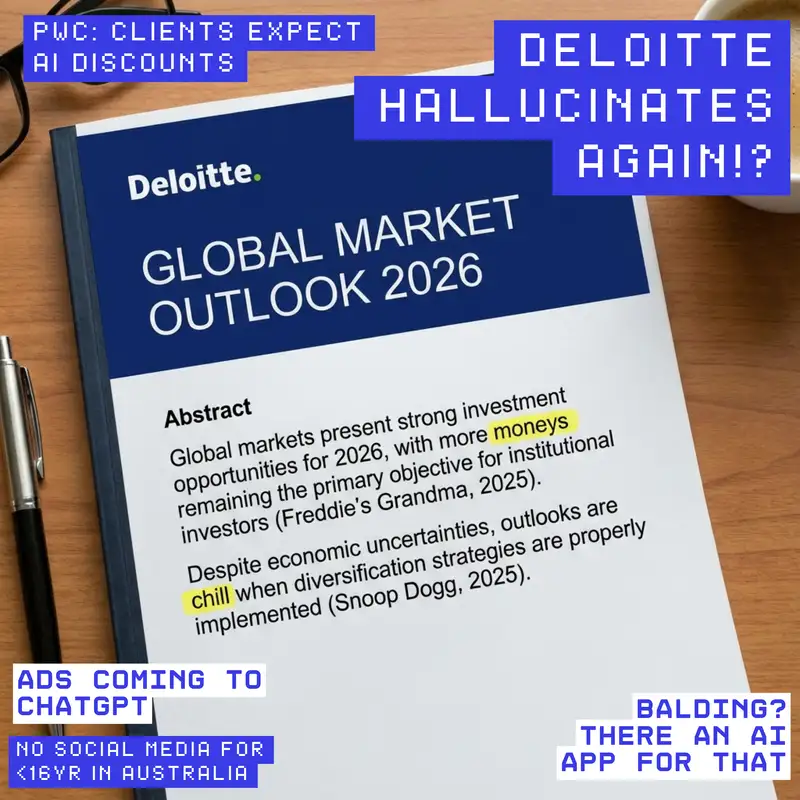
A Deloitte spokesperson says the firm stands behind recommendations in a 1.6 million dollar ⁓ health workforce report after errors traced to AI-generated citations came to light. Deloitte says it's revising a small number of citations without changing findings but hasn't addressed refunds, keeping pressure on the government. Does this surprise you, Marilla? AI ⁓ citations?
in a report by Deloitte.
Murilo (02:52)
It's not the first, right? So it doesn't surprise me. exactly. That's the thing. It's it's not surprising. I say it's not surprising that people use AI. That's not surprising at all. But the fact that it was also Deloitte, it was also for a government project. It was the Australian government. That one they had to give money back. And now this came out last week that they were also using AI because, well, again, they don't say they're using AI, but there were sources that were made up basically.
Bart (02:54)
It's not the first though.
Murilo (03:22)
Something that an AI normally would do and a person that probably would have a lot of, like, you know, if I ask you to come up with five fake sources, I think you have more harder time than AI does, right?
Bart (03:33)
And what I understood is actually like these were citations to reports by real researchers, but non-existing reports.
Murilo (03:42)
Exactly. Yeah.
So there's some claims being made. And the thing is that it's a bit interesting is that they haven't really backtracked yet. Like they're still, they still stand behind the report. They just said just the citations are wrong. Right. So apparently they, well, again, the story that I understand is that the Lloyd consultants, they have actually done the thing. They have done their homework. They have reviewed. It's just when they're doing the sources, which is a bit of the grant work, right. They use AI and maybe they select a bit off there. But then the question is,
where do these statements come from because there's like actual factual
Bart (04:16)
But this is
a bit like a student making a thesis, like writing out the thesis and then saying, need to have some authority, so I need to some citations. And you just add the citations after you've already written everything. You just find citations that corroborate whatever you're saying.
Murilo (04:20)
Yeah.
Exactly.
Exactly, they just like support.
Yeah, it's a bit backwards work. again, they still stand behind us. They're saying like, we're fully responsible for the quality. We firmly stand behind the recommendations we put forward. But it's a bit like, okay, you know, yeah. And again, Deloitte ⁓ is not a small company, right?
Bart (04:49)
It's very amateuristic, right?
Murilo (04:56)
They're expensive, they're...
Bart (04:56)
No, the Lord is not a small company.
also seen a little bit of tools that they use. And I know that they from very early on invested heavily in their own chat bots, generative AI infrastructure. So it's not that they don't have the tools, right? mean, bits what you see here, like either the tools are very immature or it's just someone that is that, that, I don't know, did some hobby work on a chat GPT without checking anything, right?
Murilo (05:12)
Yeah.
Yeah.
Yeah, but that's the way to imagine happen, right? Like I don't think it's the tools problem. I think it's really the, it's a people problem, right? Like they probably just didn't review. They thought like, okay, you know, like they were lazy or they were just pressed for time. Maybe, you know, maybe they had too much to do.
Bart (05:35)
Because
if you generate a lot of tags, know that this happens, right? Like if you have any experience with... ⁓
Murilo (05:40)
For sure,
for sure. And I think if someone calls out, you have to take accountability for it as well, Like, yeah, okay, I made a mistake, right? Basically. it's again, think the thing, the only thing that is a bit surprising is that it's Deloitte and I think it was one month ago, right? That the Australian government thing. So yeah, I think it was like maybe a month or maybe a few more. So.
Bart (06:03)
So what are
you saying? The previous one was at the Australian government. ⁓
Murilo (06:07)
Yeah, so last month Deloitte was causing a similar scandal in Australia, right? So
I think maybe that's the only thing that is a bit surprising that it took them less than two months to from different countries, of course, different teams, like, it's like this, but like, feel like it's something that is, it catches your attention, right? Like, I feel like you're working on Deloitte, our colleagues in Australia had to pay back this much money.
Bart (06:19)
Well, it's a huge organization, right?
Huh.
Murilo (06:34)
Let's be careful people, know, like it's, don't know. That's why to me it's a bit.
Bart (06:38)
But it's clearly like, it's this, like to me, this is like just a consultant that's fucked up. But, but, but to me, this more brings in question, like what is the, is there even a scientific method? If you can just say we stand behind everything, even though the citations were fake, right? Like what, what did you base your research on then?
Murilo (06:45)
Yeah.
Yeah, that's true.
So the best case scenario is like there were citations, but then Chatchpt just linked to the wrong citation somehow. Right. That's the best case scenario. Yeah, let's. But also, yeah, to me, it's still a bit. Again, another one. I wonder how many of these we're going to see like next year.
Bart (07:06)
Let's hope that's the problem.
Murilo (07:16)
And the other thing as well is like, if AI gets better and it doesn't make these mistakes anymore, you're going to also find it less, right? But it doesn't solve the problem because the problem is that people are not reviewing these things, right?
Bart (07:27)
Well, the problem is also a bit like that with very little work you can generate a lot of output, but then the actual amount of work becomes the reviewing the output while people already have the feeling that they're finished by then.
Murilo (07:38)
Yeah.
Yeah, yeah, yeah. I feel like the workload shifts a bit, right? It's kind of like coding away, right? Like writing the code now takes less and actually reviewing the output is the thing that takes the longest, right? So, and I wonder also if this is gonna change a bit the skills that you need to have, like, I don't know, like even people that type fast or people that can produce all our documents fast. Now it doesn't matter,
Bart (07:45)
Yeah.
⁓
Yeah, definitely skills, but I think at an organizational level, you also need to the tools, right? Like they're building reports probably, like very frequently. Like this does not seem difficult to have an agentic support that basically just checks citations, or not they're at the very least real, right? It doesn't seem difficult.
Murilo (08:24)
Yeah, that's true, right?
it's in something like probably you and I, if we, we, in afternoon, we just think about it, we can, we can hack something like, okay, you know, like, it's, it's not like we're not the first ones to have this problem. They're not the first ones either. And I'm sure, I'm sure it won't be the last, right? So it's also a bit surprising.
Maybe bit related to that, Yes. We have, PwC is fielding an awkward ask from some clients. If AI makes work faster, where's your discount? The report says firms are nudging prices down and moving to outcome-based fees, signaling the pressure of the big force billable hour model as automation spreads. So it's very related to this, right? ⁓
Bart (08:45)
We have more news from the big four.
Murilo (09:13)
Basically, TLDR, what I understood is that the big four, ⁓ so Deloitte, PwC, EY, KPMG, were very vocal about how AI has made things efficient for them and how they're so much faster and saving costs for them and all these things. ⁓ And as a reaction to that, their customers started saying, well, if you spend less time because now you're using AI, why are we paying you just as much?
Bart (09:28)
Basically.
Murilo (09:42)
as you used to invest, right? Like, so if before you had to pay a person a full day to work this and now you pay one person three hours, why are we still paying for the full day? So they also started to ask for the discounts there. What do you think of this part? Do you think this is surprising in any way?
Bart (09:57)
well, no, it's not surprising when, when you're the, the, the supplier of a service and you say, I'm with AI, I'm so much more efficient. it takes me only like a 10 % of the time it originally took me like customers are gonna ask you like, why am I still paying the same amount? And, right. And you can like very, very short term. I think you can say you're paying for the output, you're paying for the quality, which
Murilo (09:59)
Okay.
Yeah, exactly.
Bart (10:24)
It's probably true for some period, like at the end of the day, it's market dynamics, right? Someone else will do it for cheaper if it's actually more efficient.
Murilo (10:32)
For sure, for sure. Also, I wonder if the, example, the story we're just talking about, how the review of the AI output wasn't as thorough, maybe, as it should have been. If it also, you know, like, yeah, if we, I'm not gonna pay you this much to just ask KGBT to do the things for you, right?
Bart (10:43)
Well.
I think if people experience that, that basically the quality is deteriorating, like that will even like worsen this situation, right? But I think what the promise is to the economy at large is that AI will do value creation. And like everybody wants their fair share in that, right? Like in this case consultancy firm, but also their clients, right?
Murilo (11:02)
Yeah.
Yeah, for sure. Yeah, indeed. And again, on this article, at least they are saying that there's a lot of things that they already automate. And there is a lot of, I don't know if we actually covered this, but there was a topic that we saw on our feed, let's say, that the US market as well, and how many jobs AI is taking away, how many jobs AI has created, and the market growth in the US and all these things. But there are some jobs that will be very impacted by AI for sure.
some of the more like, I don't know, not even grunt work, right? But like a lot of stuff in the legal department that, for example, there was like a banks maybe need to review statements and you have some qualifying statements that you need to assess, right? Is this high risk? Is this low risk? And I've seen that sometimes people claim that even human reviewers have, it's very error prone, right? And have the AI review that, still having a person of course reviewing second.
⁓ can make it more efficient, can make it more accurate. So I do feel like AI will also impact a lot, both in terms of accuracy, but here I think more relevant is the time that you spend. And then it kind of begs the question, like, okay, then is AI doing the work? Are we paying you to send something to AI? Like, are we paying for the AI tool that you have? Would it be better to pay someone to build that tool for us so we don't have to pay you?
to just have someone using that tool. I think it changes a bit the dynamics of all the things.
Bart (12:46)
Hmm.
Yeah, I think the consultancy firms have all the incentives to be quite vague on this, right? Because I think for a lot of consultancy firms today, the reality is that their business model is simply time material for every hour that you work for a customer, you send basically an invoice for that time, right? So it's very linked to actual work by a human being done and the time it takes. I think it will probably go to going...
Murilo (12:54)
Yeah.
Yeah.
Bart (13:16)
going towards the future, it will have a, we will see revisions of that, of that business model. ⁓
Murilo (13:23)
For
sure.
Bart (13:23)
⁓ No, not these, think. I think especially in the consulting world, there might be a big impact. And I was actually a bit unrelated to this article, but in another situation, I was this morning
Murilo (13:30)
Indeed.
Bart (13:37)
looking at four or five large consultancy firms that are on the stock exchange and comparing them to S &P 500 and MSCI and you actually see that the last six, seven months, ⁓ stock prices have been going strongly down for these companies. ⁓ For these ones. And I think that is really like just also the market expecting that this will be challenging for consultancy companies.
Murilo (13:53)
for these ones, for the big four here.
True, true. Yeah, very true. And do you think that someone else, like, so if they're going to be quote unquote losing a bit more, do you think this benefits another group that is not obvious? Like, is there another type of consultancy that maybe will or do you think is really just the big AI players that will benefit from this?
Bart (14:25)
the token investors, the big AI players in this case. But I think just an LM model on its own doesn't do much, right? You really need to have this domain-specific expertise. think we're also seeing in the creative space, true expertise, true skills will be maybe valued more than they are today. And everything that is average and lower will be...
Murilo (14:31)
Yeah.
Well, it's a bit...
Bart (14:52)
will be valued way less. I that's a bit what we will also see in this space.
Murilo (14:55)
Yeah.
Yeah, think the thing, yeah, it's true, it's true. Even for myself, I've started to wonder because sometimes I use AI to draft, I don't know, I make an announcement for my team and like, I've started to question like for certain, depending on what it is, if it makes more sense for me to read and draft it because I still edit, so I still make sure it's my tone and et cetera, try to make it not so, I don't know, to HPT, make sure the content is there, the structure.
But I'm wondering if even that is too much bias for the stuff I'm writing, you know, like the word choice or something. I wouldn't be better off to just spend more time typing things myself, but then I wonder what's the impact that it has on the people, right? Like if you have a group of, I don't know if I said a general announcement to the team. that's like, let's say 150 people. And if it makes a difference, if over time,
It feels less AI generated. It feels more authentic. that again, there's a bit of an assumption there as well that even if I type myself, will feel more authentic, right? Like maybe, maybe you won't, but assuming that it will, right?
Bart (16:03)
I think if
for a moment it's clearly AI generated, people have the feeling like you're not doing really the effort in communicating.
Murilo (16:09)
Yeah, exactly.
Yeah. And I feel like I've always been mindful of that. But I'm wondering if even having like just a stroke, like how much input can it take that it still feels authentic, that it still doesn't feel like it's just the I generated, right? Because sometimes for me, how to structure something, you know, like I feel like sometimes I take too much time on these things. So that's also why I look at AI, but I'm not sure if...
Bart (16:34)
Yeah.
Murilo (16:34)
is
the way to go or not.
Bart (16:35)
Yeah, but it's maybe also a bit preferences. choosing where you want to put your effort, right? Where does it create the most amount of value? Because I think for example, the, what we were discussing earlier, the healthcare report by Deloitte, I think the people receiving it, they don't care who or what generated it. They want to make sure that it's correct. Correctness is more important than this has been, every letter has been typed by a person.
Murilo (16:42)
Yeah, that's true.
Yeah, that's true. That's true.
Yeah, that's true. Yeah, that's true. I see what you're saying. He's more like, objective, quote unquote.
Bart (17:02)
really depends on the, yeah,
while the use case that you are bringing is like a relationship that you're building with a team, which is probably something that like, maybe you don't have to be 100 % correct all the time, but like you want to be authentic.
Murilo (17:09)
Yeah, yeah, I see what you're That's true.
Yeah, it's better maybe to... for it to make a few mistakes, but... you know? Yeah, I see what you're saying. Yeah, it's true, it's true. ⁓ It's a good point. Well, something to reflect. And now moving on. What do we have, Bart?
Bart (17:20)
Yeah, to be a bit colorful.
We have a rumor. ⁓
Murilo (17:34)
Is it a rumor? I thought it was confirmed. I saw it somewhere else as well.
Bart (17:38)
I think... well, there's... wait, let me announce it and then we'll discuss. There is uh code in a beta of chat GPT's Android app pointing to ads that are on the way, echoing recent reporting that OpenAI will test advertisement to bolster revenue. The twist...
Murilo (17:43)
Yeah.
Bart (17:56)
iPhone users may bypass ads by invoking serious chat GPT fallback, raising messy questions about parity across platforms and plans. ⁓ Well yeah, it's rumored in a sense that it's not published yet, but there are some code fragments in the actual app that are pointing to this. ⁓ Which is ⁓ very different.
Murilo (18:12)
It's not official.
Bart (18:24)
than what Sam Altman said a year ago on this topic. I want to say a year ago, maybe it's a bit longer already, where he was very ⁓ against ⁓ having ads in the app. And we really was like, is like a last resort if we need to fall back to ads in the Chess GPT app. And he will actually expand on this quite a bit ⁓ in a podcast that I actually listened at that point.
I forgot which podcast exactly. ⁓ And he went to quite a bit of detail that this would never be a thing unless they were really forced to do it. But how it's looking now is that there will actually ⁓ be ads in ChetGPT. And I'm very much wondering how it will be executed. So I think I hope if it is there that it's only in the free version.
And that is a page user, don't have it. And if it's in the free version, if there is advertisement, then I hope it will be very explicit. And not like worked into the text answer, right? That you get these very biased answers.
Murilo (19:23)
Don't be like.
The answer. Yeah. Yeah.
Yeah, it's like, actually there's a no, what is it? I don't know. I think a black mirror episode, but I don't think that's what it is. But it's just like in the answer, like ⁓ I have a bit of a headache. yeah, you should try taking Advil because for Advil, you know, like something like that.
Bart (19:35)
Thank you.
Yeah.
Yeah, like, can
you explain to me what a pop soda is? yeah, it's this fizzy drink, and by the way, Coca Cola's really the best one.
Murilo (19:47)
Yeah.
Yeah, yeah, yeah. If
you want to try a good, Coca-Cola, you know, like that would be, that would suck. But also like for a few things, right? Like if he was really, well, three things, Sam Maltman, he was really against it and he said he's not going to do it unless he really has to and he's doing ads, it means he really has to, which also gives a signal how healthy the company is.
Bart (19:54)
Yeah, yeah, yeah.
Well, we've heard more of these rumors in the last month,
Murilo (20:18)
Yeah,
so there's that. The other thing is other I models are getting really good and I feel like would that be enough for people to move away a bit from Chagypti? Like if they start seeing ads and they're like, okay, I'll just use Gemini. I'll just use, I don't know. You don't think so?
Bart (20:32)
I doubt it, to be honest. In a sense
that... ⁓
Well, if this is limited to the free tier, to me, whenever I'm like everybody, like 90 % of everybody that I know, they have the Chachipiti app installed. And from the moment that they're not intact themselves, it's almost always a free version.
Murilo (20:47)
Mm.
Yeah, it's
Bart (20:52)
And I think there are very few people that at this point, if you don't use it in your day to day for your job, there are very few people that want to pay for this. And I fear that it will be okay for them to deal with ads,
Murilo (21:07)
But do you think like if, like okay, people don't want to pay for this, but there's like Gemini, which is getting really good or maybe...
Bart (21:14)
Does Gemini have a free tier actually? I don't know.
Murilo (21:15)
I'm this.
Bart (21:17)
Yeah, you're right. You just need to have a Google account.
Murilo (21:19)
Exactly. Yeah.
So I'm just wondering like if that can be like the push that people like, Oh, let me try Gemini because I'm sick of tired. ads and they're like, Oh, actually this is, this is good. This is good actually. Yeah. Like, maybe I can, I can see myself using Gemini. Yeah. Fuck, fuck. You know, like I don't want to see ads anymore. Um,
Bart (21:25)
Yeah, that could be.
That could be,
but that would assume that providing Gemini for free is a sustainable business model. think all providers are hammering cash at the moment just to build user base. I mean, you can't really say that Google doesn't make bank on ads, right? Google's existence is based on ads.
Murilo (21:44)
Yeah, yeah, maybe.
Yeah, yeah, yeah, yeah. It's just like, it's not on your, it's not on the Gemini space, right?
Yeah, yeah, no, it's very true. It's very true. ⁓ The last thing that I thought when I read this as like, iPhone users, so the idea, the hypothesis here is that iPhone users can avoid this because Apple had a partnership with OpenAI, right? Yes, yeah, so they have a partnership ⁓ that basically they can use, they can use Chaggpt and the data is not going to be trained. And the assumption here is that
Bart (22:14)
Yes, as in partnership.
Murilo (22:27)
It makes sense that if they're ads, they're not going to include ads in the same deal, right? They're not going to sell 10 ads to Apple partners.
Bart (22:33)
Well,
what you can do, I do it for example, my phone. So in Apple intelligence, you can log in with your Chess GPT account and then you actually use Chess GPT under the hood for ceremonies and text completion and stuff like that. But what the article is hinting towards is that Apple will not allow this for the user experience to like basically within their native, because it feels very Apple native when you use this, that within that flow that they will allow.
Murilo (22:46)
Okay.
Bart (23:02)
ads coming from OpenAI. Well, that's what the article is bit hinting towards. Which I would also doubt that Apple would allow this.
Murilo (23:05)
they will not, right? Yeah, that's what they are. So again, nothing is confirmed, but
like if you link your Siri with ChachiPT, it's your paid ChachiPT.
Bart (23:18)
Yeah, yeah. Well, I have a page. I don't know if you can link it with your free, to be honest.
Murilo (23:23)
Because there was also like a thing with Apple intelligence that I remember like if there is a question that Siri cannot answer, it would send it to Chai GPT and it would say, ah, according to Chai GPT this and this and this from the Apple intelligence announcement from a while ago. So I thought that's what it was about, but like what you're saying is something different as well,
Bart (23:42)
That's what I understood.
Murilo (23:43)
Yeah.
And also my thought was like, finally, Siri is going to be useful, you know, like Siri for the win. That's what I'm saying. Okay. Okay. And anyone can link Siri with Chagypti, you're saying. Oh, maybe, maybe not if you have a free account, but.
Bart (23:51)
Let's wait and see. So far it's not really great.
With a paid one you definitely can. I'm not sure about a one.
Murilo (24:06)
Okay, with the pay one, it definitely
can. Okay, cool. so the audio thing, it also from... The audio, is it from Siri or is it directly from ChaiGPT as well?
Bart (24:18)
No, it's not even audio,
it's just text completion and stuff like that. It comes from the Apple intelligence.
Murilo (24:21)
Just test completion.
Cool, interesting. Let's see what happens then. Let's see.
What is next? It's my turn, think, Australia's world's first under 16 social media ban takes effect on December 10th, forcing platforms to deactivate teen accounts or face fines up to almost 50 million Australian dollars. Appeals will rely on age assurance checks like videos, video selfies or IDs, stoking debate over errors, privacy and free speech challenges.
Bart (24:32)
Yes.
Murilo (24:54)
This we talked about something in Europe, right? Which is different from this. So this is Australia, the Australian government. They are putting forward under 16 social media ban and this is starting like in 10 days. So basically if you're under 16, you are not going to be allowed to have an account in actually a lot of platforms. I think it was said here like ex Twitter, TikTok, sorry, ex Twitter.
X, TikTok, Metta, Instagram. So a lot of them actually. There are a few.
Bart (25:27)
Facebook, TikTok,
Snapchat, X, YouTube, Reddit, Twitch and Kik. ⁓ And they will be ⁓ forced to deactivate ⁓ under 16 accounts. ⁓ There are ⁓ two that are exempt, which is LinkedIn. ⁓ Which where you could say something about, right?
Murilo (25:33)
Yes, I don't know kick actually, but...
Yep.
Bart (25:50)
Maybe if you're in college there's some value in that. Which I do not really understand. It's also exempted YouTube kids.
Murilo (25:59)
So YouTube Kids is like a different app from YouTube?
Bart (26:04)
It's a different app from YouTube. It's basically like YouTube with a filter on. So only quote unquote fit for kids content is available there. But it's like really like a cancer to your brain. It's like 80 % of like, it's really brain rot videos. Like it's 80 % like I think it's generating stuff with a jingle on it. And I completely forbid it in my household.
Murilo (26:14)
Okay.
It's like brain rot.
Bart (26:31)
for my kids. I blocked it, yeah. And I think especially because YouTube kids is like, for even like very young kids, right? Like it's like, you quote unquote start on this until you're 10, 11. I think it's maybe even more vulnerable age and I don't really understand why they would allow it. But I can imagine that YouTube already had...
Murilo (26:31)
Yeah, you blocked it. You enacted this. It's like a jurification.
Mmm.
Bart (26:56)
all the paperwork ready, saying, we come from this platform and then we filter everything out. So I think they did a lot of lobby work there.
Murilo (27:04)
Yeah, like he says, like, there be any challenge to the band? And then he says, your YouTube has threatened to launch a high court challenge. So maybe there was, I mean, this is YouTube and not YouTube kids, right? So maybe there was already a lot of work to put there. So yeah, there's like, they also say, if you have an account now, then basically they're gonna delete your account or they're gonna freeze your account.
Different platforms can do things different ways, right? So basically if you have a lot of messages or if you have a lot of photos you can download them or you'll be frozen until you're over 16. There is a PO process if you're misclassified as under 16, right?
Bart (27:41)
Yeah. The
problem with appeals processes is that you need to verify your age. Basically with like sort of an age assurance tool, like can be video softs, be like bank card checks or really facial IDs, which also like brings in a question a bit like, what about privacy? What if there is a data leak? it's...
Murilo (28:00)
Yeah.
Yeah. And maybe one thought that I had. I think it's good. ⁓ I think it's good. But the thing for me is I thought it was good even before the whole Gen.ai wave, right? I think I was lucky that I grew up where social media became a thing when I was older, like not like not.
Bart (28:04)
What is your opinion on this, Marilla?
Murilo (28:23)
18 or something, was still a like when I was really young social media wasn't a thing, right? And we, I think we talked, I don't know if we talked about here, but like you hear stories about like cyber bullying, right? Like how if there was someone that was like an asshole at school, when you get home, you were safe, quote unquote, right? Like there was nothing. But now because we are connected a hundred percent of the time, you don't get a stop from that. And also the internet provides anonymity, quote unquote, right? To a lot of kids that gives.
I mean you see a lot of trolls online right people that are very tough, you know And when you add that to to kids like so I'm happy like mom happy I didn't have to live through that and I'm grateful that I didn't have to to grow up on this right I think so I think this is good
Bart (28:53)
True, ⁓
Uh-oh.
Yeah,
I think, but also let me like to add on to that, I think a lot of people show typically is like the best part of their lives. Like people that feel miserable, have a look online and say, everybody's other life is way better than mine. And then you have like, influencer basically abusing this group of people that are very vulnerable. ⁓ So yeah, I'm also tended to say that this is a...
Murilo (29:14)
Yeah.
Yeah. Yeah.
Yeah, it's a lot of those.
Bart (29:33)
This is a good thing that is happening. Even aside from the whole addiction part to this, Because social media can be also very addictive. this becomes a bit like your concentration goes to your social media because that's where you get your endorphin head, which is maybe also not the greatest in that part of your life, right?
Murilo (29:35)
For sure.
Yeah. Yeah.
For sure, think, especially for kids, right? Cause I feel like kids, I mean, I imagine they have a harder time like self-regulating, understanding themselves. I do feel like today I notice much more like if I spend too much time on social media, how I feel afterwards, or even if I eat something. And feel like when you're a kid, you're not as aware, you're not as in tune, right? So I do feel like there's a lot of negative things that can come from overuse.
Bart (30:13)
Hmm.
Murilo (30:19)
Like you said, also the misaligned expectations, Like you think like during COVID happened a lot, right? Like the digital nomads, my life is amazing, look at this. And it's like, it's not really like that, right? Like no life is perfect. Like, yeah, some things are good. I'm saying that, I don't even think it's something malicious sometimes from people, right? Like I'm not gonna go on my Instagram and post pictures of me when I'm sad, right? I'm only gonna pictures of me when I'm happy. But then...
Bart (30:27)
Yeah, that's true.
Yeah.
Murilo (30:47)
you need to kind of think like, okay, but Merle's not happy all the time. Right. But I think for kids it's a 90%, 99. But I think for, I think it's good. To me, I was also like, why did we wait so long? That's a bit of feeling, right? And they don't talk a lot about in this article why now I'm assuming that is a lot of the GNI stuff and like the quote unquote brain rot.
Bart (30:52)
You're not.
Murilo (31:12)
I think it's good that it happened now, but to me it's like it could have happened sooner as well, right? That's a bit the feeling that I got.
Bart (31:18)
Well, at this level,
from the moment that you have state regulation, it always takes time,
Murilo (31:24)
Yeah, that is true. That is true. What I do hope that with this, ⁓ people are gonna be looking at it and maybe different governments are gonna see how successful or maybe they're gonna iterate on this. And this is something that will be more commonplace in different countries, right? I do think it's a positive.
Bart (31:43)
Yeah, and I think for moment that you look on the potential negative effects of these things, like it's very much a positive that this gets banned. I think at the other side, like there are also like very positive use cases. mean, a 14 year old kid that wants to do some DIY stuff and like looks it up on YouTube. I mean, it should be possible, right? But it's not gonna be possible, so yeah.
Murilo (32:04)
Yeah, that's true. Yeah, that's true.
Yeah, that's a good point. That's a good point.
Bart (32:12)
So yeah, there are also definitely downsides
Murilo (32:14)
Yeah, I think it's a tricky thing, Because the internet is a bit like a floodgate, right? Like you... It's hard to filter out like the bits that you... Like even YouTube kids, because you can say, that's safer for kids content, but like, is it? Right?
Bart (32:21)
Yeah.
Yeah, I agree.
Murilo (32:31)
Maybe one last thing, I thought it was interesting. They also mentioned that they starting with these platforms, right? But they may change things in the future, which also think is good. Basically they said, we want to avoid that we ban these and then there's a new platform that we weren't aware that everyone goes there and it kind of defeats the whole purpose, right?
Bart (32:51)
What I wonder is whether or not this will ⁓ accelerate, like which we used to have back in the day, with more local social networks.
then we will see, well, this is in Australia, maybe a new Australian social network will pop up. And because it's local, it's easier to follow all the regulations to still allow people that are younger than 16. I'm wondering if this kind of regulation will spur something like that.
Murilo (33:20)
Yeah, it's true. It's a good point. I'm also thinking of the societal, like if you have a more local network, does it encourage you to connect more locally as well? Which is maybe not a bad thing either, right? Like to...
Bart (33:34)
Well, at the very least, it becomes harder to be influenced by bots that are not even run from your own country, Well, we've heard a lot from the States in the last weeks.
Murilo (33:42)
Yeah.
Yeah, yeah, that's true.
Yeah, that's true, that's true. So let's see, let's see. think in any case, the initiative is good. As you said, I think it's a bit tricky, right? How to get the things right. But I also think that if you never start, you're never gonna get there. So I think it's a good start.
Bart (34:05)
Let's
move from, ⁓ let's say, ⁓ well-being to health.
Murilo (34:13)
Let's take a step back.
Bart (34:15)
So, My Hair, AI, promises to spot early hair loss by analyzing uploaded scalp photos and tracking density over time, pitching itself as a clearer path through a murky market. The startup claims 1,000 paying subscribers, 200,000 accounts and 300,000 images analyzed, inviting questions about medical accuracy and regulation. Yeah, I think I thought I added this one, I saw it by on TechRange and I thought this is a good example of ⁓
Is there an AI app for this? And, yes, for bowling there is one. For every topic you can now say, yeah, there is an AI app.
Murilo (34:49)
There
is an AI app. So maybe the story here, right? Like apparently it's a guy that he said, like he went to the hairdresser and the hairdresser said, you're starting to lose hair. And he didn't think he was, but then he started to freak out. And then he talks about how losing hair for men, it's a sensitive topic and how when you start looking for...
out solutions online, you get flooded with a whole bunch of stuff and there's new ones to it and you don't know how to, so he built this app to basically guide you through what are the treatment options, what are the things you can do. And actually, I think you can even track your progress over time, Like taking pictures and see if it's getting better or not. Yeah. I mean, honestly, I think...
Bart (35:32)
Yeah, that's what I'm supposed to
Murilo (35:41)
A lot of people are going to be interested in this. So I have a history of hair loss. ⁓ I wasn't as, it's a bit far from me personally. My hair was thinning and...
Bart (35:45)
Oof.
Murilo (35:56)
In my head, I was like, I'm just going to shave my head. You know, I don't want to have like the thing. I'll just shave my head. I feel like the people around me, my wife and my family, like my parents, they're the ones that are like, no, you should like, you know, just yeah, want me, you know? So like, it's fine. Like I'll do it. So I'm taking, I'm treating the hair loss, right? But it is true that like, once you start looking at it, there's a lot of stuff that people say like,
Bart (36:07)
They worry more than you.
Murilo (36:23)
micro needling and then you have different medications and there's people saying, the hard water can damage the, can cause, can produce hair loss. Yeah, in Belgium it has very hard water, so like maybe adding this filter and then there's people saying like with like oils and stuff and then you have these like massagers things and then it's like, UV light, it helps produce hair growth. And like some of these things you can like, maybe it makes sense, right? Like light because the hair is supposed to protect from sun. So maybe if you have like more UV, maybe you...
Bart (36:30)
Oh wow, we have very hard border here, right?
Murilo (36:52)
raise more hair, like you kind of, is there scientific backing to it? You don't know. So I can kind of see that. And also I think to put that with a nap, they can kind of track like I'm trying this, is this working? Objectify a bit, exactly, exactly. And then you see some people like I seen videos of like a guy that he had like really thin hair and then he had this whole routine of like doing all these different things and then he shows over time and then it.
Bart (37:02)
Like to make it, to objectify it a bit more, like, am I actually, like is it actually getting thinner?
Murilo (37:17)
The hair looks like it's getting thicker. Again, you never know, right? Because maybe he just recorded backwards, right? You don't know what happened. But it looks like he's getting better, but at the same time he's like, yeah, but he spends like 45 minutes every day doing this. Do you want to spend 45? You know, like, you know, and it's also micro-kneading is like, you see some people saying, don't do this at home. So I do think it's a bit of a, I do think it could succeed because I do think it's something that a lot of people, a lot of men.
Bart (37:30)
That's a lot, huh? That's a lot.
Murilo (37:44)
because men are not supposed to be very vain as well, right? So feel like it's something that men don't talk about as much, but I do think that...
Bart (37:49)
Hmm, yeah. But because
of the app you can be like anonymously vain. Yeah, yeah, yeah. You can still stress about it.
Murilo (37:55)
Yeah, exactly. like you can have your buddy just like,
he's like, like you're not gonna ask your bros, right? Like, how's my hair thinning? What do you think, bro? Is it better? Is it worse? What is this? You can ask your app. It's a bit more anonymous. I think it's, yeah, exactly. like, no, yeah. Yeah, it's like, it's getting thinner, but you still look beautiful. Don't worry. You know, it's like, you're still the most beautiful boy in the whole world.
Bart (38:04)
which are gonna ask your app.
Yeah, I see. Maybe there will also be like a chat companion to the app. To express your worries.
Yeah.
Murilo (38:24)
Okay, thanks.
Bart (38:25)
It makes you look mature and wise. ⁓
Murilo (38:27)
Yeah, exactly. It's like, yeah, but
the old Greek philosophers, they were bold as well. So it's fine. You know, it's like...
Bart (38:33)
So are you gonna try out the app?
Murilo (38:39)
No, probably not. But I also have talked to dermatologists as well on this. So I'm happy. I I'm happy with the amount of effort that I put and for the returns that I get. And that's it. think that's
Maybe one last thing, I think at very end he says, men worry of two things, their health, sexual dysfunction and hair loss.
Bart (39:03)
wow, this is another opportunity for an AI app then.
Murilo (39:06)
Yeah, give me the check if there's an AI for the other one. I'll just leave it at that. What is next? What is next? Is the Dutch universities, no?
Bart (39:09)
Yeah, Yeah, yeah. That's not going to happen.
Murilo (39:22)
Yes. So following a sanctions scare that briefly locked the International Criminal Court out of Microsoft email, Dutch universities are reassessing big tech dependence trials with open source suites like MaxCloud and OpenDesk show promise. Yet experts warn a full break could stall teaching and research unless institutions run costly parallel systems.
Bart (39:23)
universities.
Murilo (39:47)
So.
Bart (39:47)
Yeah,
we discussed this a few weeks ago, right? In the context of the ICC that is switching out Microsoft 365 for OpenDesk, a German product. And now we also see this chatter between Dutch universities. They thought it was an interesting evolution where they're basically testing, they're trial running, I think.
Murilo (39:59)
Yes.
Yes.
Bart (40:15)
70 ish people if I remember correctly. Both OpenDesk as well as Nexcloud which is also German if I'm not mistaken. ⁓
Murilo (40:26)
Yes.
Bart (40:26)
But
it's not like, let's switch this. Like people are still worried about both on feature parity, as well as on like, it not be way more expensive to run this ourselves?
Murilo (40:39)
Yeah, also the feature parity, there's feature parity of today, there's also future parity of tomorrow, Word is also adding a lot of AI features and a lot of stuff that makes it very attractive. ⁓
Bart (40:50)
Yeah.
And they also worry about the feature parity ⁓ aspect in the context of will it not slow us down? Will it not make us less efficient?
Murilo (41:00)
True. And they talked a lot about the Microsoft suite, but they're not talking about like, cause actually when I first, think when I read the title, Microsoft, I don't know why I thought of like Windows laptops. And I actually heard that I think I have a friend from South Africa and he said that they use Ubuntu there as well. So everything is just fully a hundred percent open source. That's not what they're saying even, right? They're just saying really the Microsoft like teams and.
all these other things that they don't want to depend on, Yeah, yeah, yeah. What I thought it was really surprising ⁓ is that the, Sierra, in the beginning, right? Like what triggered this whole thing is that chief prosecutor on international court, yeah, that's the thing that he couldn't get access, right? And it has something to do with the political views of the US and what was it? Something about Israel, right? So yeah, yeah, indeed. So.
Bart (41:29)
Yeah, more or less the Microsoft Office extended stack. Yeah, indeed, yeah.
Well, that's what we covered a few weeks ago, did you? ⁓ And that,
that makes, makes, let's say European institutions like the ICC and in this case universities like worry about like what, like how, how dependent are we on, on basically American, American tech giants? ⁓ And what if they lock us out? What happens then? Like basically like how, how sovereign can we operate or not?
Murilo (42:01)
Yeah.
Yeah.
And
also it's not like the Microsoft, which probably there's a lot of people making these decisions to need to say, want to block this. It's really just like one person, like the Trump just said, block, block. Like, know, make sanctions and basically force the hand of tech players as well, right?
Bart (42:37)
yeah, I think this
really comes from geopolitics, Like a lot of the reality is that a lot of these tech suites, are American. The American brands as such, the American brand was very trustworthy. I think that is no longer the perception, at least in Europe, that American brand is trustworthy. So maybe we need to investigate what alternatives are and that's is happening today.
Murilo (42:57)
Yeah.
Yeah, but also what I also was thinking is like they're not trustworthy, but not even it's not because Microsoft decided either, right? That's at least what I understood.
Bart (43:11)
No, exactly,
but that's what I mean. I don't mean Microsoft as a brand, but I really mean America as a brand.
Murilo (43:17)
Yeah, no, get it. it's also interesting ⁓ because Microsoft doesn't want that to happen, right? They want to serve customers. And it's also probably Microsoft, thinking a bit like, because even we see like the sovereign cloud thing, right? I think AWS has now ⁓ a European sovereign cloud and like legally, maybe they need to move some things around for like the entities and make, know, but it's like, it's also like, I don't remember any point seeing or hearing
Bart (43:24)
No, no, of course not. No, no.
Mm-hmm.
Murilo (43:45)
this struggle like Microsoft wants to do this, the client wants to do this, but now there's something else that is really blocking in the middle, right? And now it's a struggle for everyone because one person wanted to, yeah, to make everything more difficult, right? So.
Bart (43:48)
Of course not,
This is really geopolitics, right?
or one person's administration.
Murilo (44:03)
Yeah, exactly. exactly. ⁓ Indeed, it's an administration, but still feels like a...
Not a weak spot, but you know, like a loophole kinda, right? It feels like...
Bart (44:15)
Mm-hmm I also out of interest. I also I was thinking reading this article. I think like what because when we think about tech these days you also think about China like what is the main office suite use in China and apparently it's WPS office by Kingsoft like Microsoft is Microsoft is not Not such a big thing like the most widely used is this WPS office, which I
Murilo (44:41)
but
it's a free one, huh? Interesting. Because I just went on the website here and it says it's actually a free alternative. The best free alternative from Microsoft Office.
Bart (44:42)
I'd never heard of.
But I think what we see today between Europe and the US, of course, but in Hong Kong for a way longer time between China and the US, this will maybe, like these new politics might, like this might be the catalyst to actually have European contenders that are good enough to sort of everybody in Europe, basically just like that becomes the default new normal.
Murilo (45:12)
Yeah.
Bart (45:22)
And that won't go, we won't have that in one year, of course, but maybe we will have it in 15.
Murilo (45:27)
Yeah, true. And like you said, like the article they talk about whether Dutch universities can do without Microsoft. I think there was a lot of saying like, okay, if everything will go to standstill, but also I think it's. It's not like tomorrow, right? I think you would take time. think I think it's still still happen, but I think the article, maybe it's a bit when they talk about here, it looks a bit like can we do it tomorrow? I was like, yeah, tomorrow not, but.
Bart (45:46)
Yeah, definitely.
No,
no, exactly.
Murilo (45:55)
think over time, Like people need to get used to it. You need to have a pair, need to plan the idea. But I do see a future when this could be the case, right? Is this an attractive future for you personally?
Bart (46:07)
I think it's always good to have competition.
Murilo (46:08)
you don't
Bart (46:10)
Look at maybe look more from that point of view, because it also like if you start a new startup today, you first thing that you need is a domain and then an email address and then some like minimal office suite. And like basically you have like, you have like Google, you have Microsoft, maybe you have Zoho. Like that's, that's more or less it, right? Like they're like, they were already like past the 80%. Then you have a very small ones, but like all the small ones, like it takes way more effort to set stuff up.
Murilo (46:28)
⁓ No.
Yeah, that's true.
Yeah, yeah that's very true. That's true, that's true. Did you go to a Dutch university Bart? No?
Bart (46:41)
So I think it's good to have competition there.
No.
Murilo (46:49)
never mind. Now, what's next? On to something lighter maybe.
Bart (46:54)
It's your turn, I guess.
Murilo (46:57)
it's my turn, my bad. So we have Apple's rumored iPhone Fold is set to achieve a crease-free display via custom panel stack and liquid metal hinge ⁓ at a luxury price. Supply chain reports point to pre-mass production testing and a potential 2026 launch with estimates reaching $2,400-ish, setting up a high-stakes debut against seasoned foldable rivals.
So it's a foldable iPhone, basically. Very expensive foldable iPhone, right?
Bart (47:32)
Yeah, like more or less twice, well a little bit less than twice the cost of a regular iPhone.
Murilo (47:39)
Yeah, a good iPhone, right? a, yeah, very good iPhone. And I guess the crease free, right? So when you fold.
Bart (47:41)
Yeah.
And these are rumors,
I guess. These are not officially announced.
Murilo (47:51)
No, they're not indeed. So everything is rumors at this point. I don't know if iPhone fold is actually is an actual thing confirmed. But I think everything is rumors. So basically the crease, right? Like if you fold the phone too many times and you open it, even if it's touchscreen, if it works, you still see a little ⁓ thing in the middle, right? And they're saying this is going to be revolutionary because it's fold free. ⁓ Do you care about foldable phones actually?
Bart (48:09)
Exactly. ⁓
it's a good question. It's a good question. ⁓ I do...
I for a lot of things, but maybe I'm a bit atypical there. I do prefer my MacBook over my phone, so I quickly switch to my MacBook for stuff. But maybe I would do more on my phone if it would have more screen real estate. But I'm not sure, like I would have to test it out.
Murilo (48:44)
Yeah, I'm not sure either. I'm also thinking like if it's too big and if you need to like, you know, if you need to hold two hands to do stuff is also a bit...
Bart (48:51)
Yeah, that's also true, because you can't easily control it with one hand anymore. Yeah, that's also a fair point.
Murilo (48:55)
Yeah, it's like, you can grab it and just,
you know, so I don't know. I get why some people like foldable phones. I like, I get the idea as well. It's like we had the flip phones and then we had touchscreen phones and now it's a bit both, right? Like kind of open in their touchscreen. But I don't know. I probably, even if it was the same price as an iPhone, I probably wouldn't go for this to be honest.
Bart (49:17)
Yeah, was really nice to test it out. But indeed, I didn't think about this. I do a lot of things with one hand, right? Also because I'm doing something else with my other hand. That's not going into too much detail there.
Murilo (49:20)
Yeah.
Exactly. Okay, we've retarded this part.
Bart (49:36)
But basically you can't right with an iPhone fold because it's way too big to actually control it. Maybe they will optimize the UI for it, but still it's not handy.
Murilo (49:47)
I don't know, even
typing, If you need to squeeze your, I don't know, stretch your thumbs to reach the right keys, I don't know if it's...
Bart (49:54)
I
would like to try it out, but so far, never in my life, I've thought like if my phone would now be foldable, my life would change. Like never, never really had this need.
Murilo (50:06)
Never happened.
But have you ever had any like, ⁓ I wish this screen was bigger.
Or how often? think that's the more question, right? Like how often does that happen? How often do you catch yourself be like, ah, fuck it, this screen was a bit bigger I have done this year, but.
Bart (50:22)
Good
question. Probably not a lot. Oh, it's actually a lot. In this picture, you actually see that that's almost like a tablet, right? That's too big.
Murilo (50:29)
Yeah, it's huge. I mean, but
this is the foldable crease Samsung Galaxy Z Fold 4. Yeah, but like, yeah, I don't know. I feel like for me it's like, why, why can't we let a phone be a phone? Why do we want to do everything with everything, you know?
Bart (50:37)
Let's bake ya.
So you're saying Baker is not always better.
Murilo (50:49)
It's how you use it, right?
⁓ yeah.
Bart (50:55)
Okay,
let's see if it ever gets announced, because they were saying a potential 2026 launch.
Murilo (50:59)
Let's see if it gets announced.
Yeah,
also they said that they would make a big deal about this, right? Like I saw somewhere here that every September they usually announce an iPhone, but then they would do like a separate thing for this iPhone. So maybe it would be a bit more traction. But I also thought just occurred to me now, do you feel like sometimes they're struggling a bit to innovate with iPhones? Like...
Bart (51:28)
I think that is definitely the case, there's been more or less incremental improvements over time. Nothing truly innovative anymore. I mean, it's good product.
Murilo (51:34)
Yeah.
I think the last big change they made that I felt was the they didn't have the button anymore. think that's the last. Yeah, exactly. That was like a fingerprint thingy. It's all face. That's the only thing that really changed. But aside from that.
Bart (51:45)
Hmm. Yeah, yes, the home button. Yeah, that's true.
Let's see if anyone listening has a very good use case for a foldable iPhone, let us know.
Murilo (52:02)
Indeed, let us know and then you can buy your sock, right? We also cover that. You can put the sock in there.
Bart (52:08)
the iPhone sock,
that's a different name, but like this $250 basically a sock that you can put your iPhone in. But yeah, it's by Apple, so you can't go below 200 euros for any accessories. So.
Murilo (52:14)
Yeah.
Exactly, exactly.
I think so. Otherwise, yeah. What's
the last step? Last step, what do we have?
Bart (52:29)
We have Meta. Meta unveiled SAM 3 and SAM 3D, models that segment objects from text prompts and reconstruct 3D objects or bodies from a single image. The release includes open source weights, a playground, and claims of state-of-the-art performance. Positioning 3D from 2D is a practical tool for creators, robotics, and AR. They're showing the website here. It's actually very impressive, very performant. They have a model that... ⁓
basically segments objects out of an image or out of a video. So really it becomes easy to identify and extract stuff. But it also does that sort of, I want to say the other way around, but it's maybe not really correct, but going from an image to understand the image and also to understand how it would look like in a 3D world and to basically generate that 3D model, which also works.
very impressive. Not perfect. The demos that are showing here on the landing page, are all very impressive. We tested it out with a few things. It still impressive, but not as great as here. But also, there's a playground. It's very easy to get started and to just upload your stuff. It doesn't cause anything. ⁓ So definitely do check it out.
Murilo (53:47)
Yeah, so the segment anything model is not new, right? Like it's been there for some time. ⁓ do, well, it is impressive. So maybe.
Bart (53:53)
Hmm, no.
Murilo (54:02)
The way that I encountered it before was like, you have some machine learning task, right? And you want to classify things. So maybe you would first use the segment anything model to segment objects. And then you just take that. So for example, if you want to have a picture, whether you have cats or dogs, maybe some of these pictures are in the nature. And to make it better for your model to classify, you segment just the object, whatever that is. And then you pass that through a second model to actually classify this, right? ⁓
Bart (54:27)
Is it clear?
Murilo (54:29)
This looks a bit like they also have some applications like AR, right? Like if you're gonna style your living room, how you want to see happening. So maybe you also want to take a picture and like have a 3D rendering so you can also play around with the image. They also had it very in here and maybe I'll play hopefully we don't get with the copywriting. ⁓ On the playground, right? Like you can select, there's some strange videos here which actually I think that the model, I saw some demos as well that they also have video.
But they also talk about like editing the background, right? Like, so if you want to do some videos and you have the contours or something, or if you want to like this, the example here is like a basketball game and you can remove the background and put something like sexy or something. So even like more application facing, right? Things, which I think is also very cool, right? Like I think there's a lot of stuff you can do, but it didn't, because of my bias of...
Bart (55:11)
Yeah, yeah, did you?
Murilo (55:19)
having used it before for machine learning tasks, I didn't actually think about it before, but it's actually really cool.
Bart (55:24)
Yeah, definitely.
Murilo (55:27)
Maybe
also one thing I can show. I think this is from the same model. So I think this is a...
think this is a meta research actually, I don't know who it is. But basically, they create a lot of Gen.AI, there's definitely Gen.AI, right? Like videos of like a cat playing fiddle and then it's like the cat is doing stuff outside and then every time you can actually classify, can segment the cat and classify it correctly, right? But it's like just some absurd stuff. It's just funny. Cause actually the videos look really good, huh? Like...
Bart (55:58)
So these are
videos generated by Sora, so non-existing ones, right? But it's still able to segment quite well, right? So it's still able to classify a cat playing instruments.
Murilo (56:07)
Yeah, indeed. But like the videos are just...
Yeah, exactly, exactly. Which is really impressive, ⁓ also the videos are actually quite impressive, like the physics and all these things. So I thought it was pretty funny.
Bart (56:15)
Yeah, yeah.
trying to see if I can quickly ⁓ show a demo. ⁓ But let me see if I can share my screen.
Murilo (56:31)
Oof, please do.
Bart (56:37)
seconds.
Here is one of the examples where you can go to the playground. It's aidemos.meta.com and like this is the example you can go from basically an image to a
to 3D model.
I'm gonna see if I have an image of Merillo, which I just happen to have in my downloaded assets. And then you basically need to basically click here to select the object and it will try to auto basically segment that. This does it quite well with just one click. And then I click generate 3D model and then we're gonna see an actual 3D version of Merillo. ⁓
Murilo (57:00)
Bye.
This is really good, yeah?
Bart (57:18)
Yeah, this is...
Murilo (57:20)
Whoa, what? What? Get out of here. Damn. Uncanny. Jesus, it's like I'm there.
Bart (57:21)
Wow, this is like...
That's crazy, ⁓
Yeah, yeah, I didn't expect this level of performance though. This is next level, right?
Murilo (57:34)
like really wow okay maybe for people listening describe
Bart (57:35)
Huh?
It's like you went into another dimension and came back all distorted, something like that. Right? Like you still have the same color of hair, you sort of have to lie the same t-shirt on, like your neck turned white and then your... You've got a really big nose, yeah.
Murilo (57:47)
Yeah.
Yeah.
My nose got really big as well. Right? I feel like
if I had a, if I create an avatar in like 2003 on a video game, that's kind of how it would look like.
Bart (58:08)
⁓ exactly in 2003, yeah.
Murilo (58:11)
You
know, it's like, But I guess with, but I guess people is difficult as well, no? feel like objects is probably better performance, no?
Bart (58:14)
⁓ So yeah, that's fun.
Murilo (58:23)
Yeah, I saw. I just closed it.
All righty. Probably this is better with objects than with people, right?
Bart (58:27)
Let's assume, yeah. The demos that they showed on the landing page were at the very least way better than trying to make a 3D model out of you.
Murilo (58:29)
Let's assume... Let's assume, let's assume.
The demos they showed is like you can see the crease on the paper, you know, it's it's insane, That's what we had for today. Maybe just one last, last, last tidbit that I wanted to quickly share. Well, maybe two tidbits. Maybe one here is, me share this. We are, this is, we're in December, part, and you know, the first of December, and you know what this means?
Bart (58:57)
Yes, first of December, while we're recording.
Murilo (59:01)
Yes, this means Advent of Code is here. So Advent calendar, usually you have like the chocolates or whatever, right? One per day until the 25th. ⁓ And then there's one for coding. So if you have any, if you'd like to try some Christmas themed puzzles, they have a whole bunch here. Actually this year, he changed actually. I think he's doing from the 1st into the 12th actually. So he's not doing 25 days anymore.
Bart (59:04)
Yeah.
I am.
Okay.
Murilo (59:28)
Yeah, yeah, so here. ⁓ Basically says, yeah, it was taking too much time for me. ⁓ So that changed.
Bart (59:37)
Is it a
single person that is running all this? Because it's a big challenge and it's been around for at the very least 10 years I want to say.
Murilo (59:40)
I think so. yeah. Yeah.
Yeah, that's exactly what he said. ⁓ Where is it? Why did numbers change? It takes a lot of time for to create and then after building this for 10 years, see after keeping consistent strategy for 10 years, I need that change. So indeed. So he's going to stop on the 12th of December and then I guess you can also enjoy his holidays. He's also not doing the global leaderboard because I think he mentions is the biggest source of stress from him, right? To make sure nothing blows up, I guess. ⁓
Bart (59:57)
⁓
Hmm.
Murilo (1:00:17)
still very happy that this still exists. I also wonder how JNI is going to impact on this. Like, because we launched this and my current employer, but we also would be like, how much should we, you know, like if you were just using AI to solve all these things, is it still fun? Is it still worth it?
Bart (1:00:23)
Sure.
for the truly competitive people they just want their main aim is to just get it solved as quickly as possible and get the most points possible right
Murilo (1:00:39)
just wanna.
Yeah.
Bart (1:00:44)
It's interesting to see.
Murilo (1:00:46)
So yeah, think it was the first year that I was actually, like I was actually wondering, you know, like is it still?
Bart (1:00:52)
But it's probably the first year like that where AI with very little tweaking can get very close to an answer.
Murilo (1:00:56)
Yeah, exactly. I think
less and I think last year, because we have our yearly conference as well, I remember there were people that tested out Gemini, Cloud and OpenAI, ⁓ Chagpt with the advent of code, right? So they literally just tried just launching the puzzles and I think they said that all of them, couldn't get past the second day or something, or maybe like one got past the third day. So was still a big gap. I...
Bart (1:01:18)
Hmm.
Murilo (1:01:23)
feel like today that's not gonna be, I think today they're gonna be much better. So I'm also wondering if this played a role for him to do less challenges, right? Like how much time do you want to invest on all these things? you know, like it's probably gonna be hard to build a challenge where AI cannot just solve it.
Bart (1:01:41)
Especially going forward. Like... yeah.
Murilo (1:01:42)
especially going forward, right?
So, yeah. But the advent of code is here. So, if people would like to.
Bart (1:01:49)
So three years from now, we'll just have agents in the background solving everything for you. Like you're not even touching it anymore.
Murilo (1:01:54)
Exactly,
exactly. Or maybe the admin of code will be just for agents, you know, it's going to be like different types. So it's going to be like, it's going to be a riddle. And then, you know, the riddles, the challenge for the AI, not the coding part. And then, yeah, think that's it for, for today. Unless there's any parting words you want to share with us Bart.
Bart (1:01:59)
Yeah, yeah.
Yeah.
⁓ No, guess now I'll have to start making photos of the top of my hat and see what the progression is.
Murilo (1:02:25)
I think you're fine. I think you're fine. I think you got a full head of hair. I think you're good in this one. You're good. ⁓ Maybe this week we are going to release the episode, first episode with Sam for Fabric Data Days. Is that the name?
Bart (1:02:33)
Let's see. Let's see.
⁓
Yeah, so we recorded, we hinted towards it last time, we recorded an interview with Microsoft MVP around data analytics focusing on Microsoft Fabric. it's, what's it's already is Microsoft Fabric days. And if not, it will start soon. ⁓ And in that context, we're also gonna need like release all that ⁓ this Friday.
Murilo (1:03:02)
think so, think. Let me check.
Yes, yes, yes. So stay tuned. We're also going to have other guests that we're going to be interviewing. So yeah. And as always, thanks for everyone to listen, to watch, to subscribe, that are on our newsletter. Really appreciate it.
Bart (1:03:31)
See you soon.
Murilo (1:03:32)
Talk to you later, ciao!
Bart (1:03:34)
Ciao!
Creators and Guests