Code Red, IBM Eats, Sloppy Speech & Open Source Shake-Ups
Murilo (00:08)
Hi everyone, welcome to the Monkey Patching Podcast, where go bananas about all things buns, chatbot dialects, and more. My name is Murilo I'm joined by my friend Bart. Hey Bart!
Bart (00:16)
Hey, Murilo
Murilo (00:17)
How are you?
Bart (00:18)
I'm doing good, I'm doing good, you?
Murilo (00:19)
Doing good, doing good. feel like we had a lot of topics this week. Had to, we had to trim it down. Some spilled over. Yeah, yeah. So let's get to it. Should you start or should I start?
Bart (00:25)
There was a lot of news here.
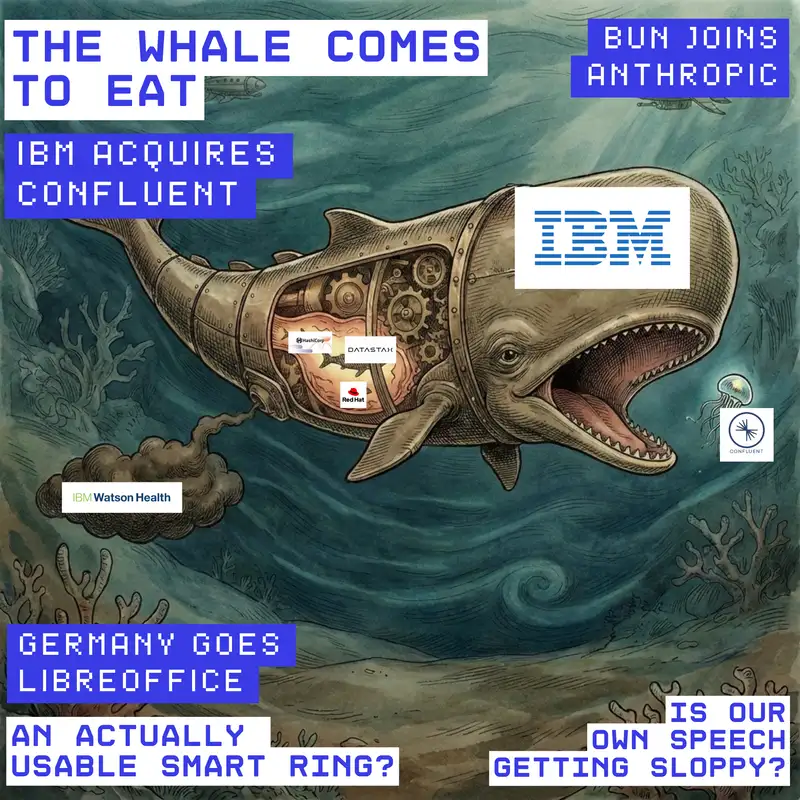
JavaScript runtime bun has been bought by AI lab and Tropic, which will use it to power Cloth code and other tools while keeping the project open source and led by the same team. The deal swaps startup uncertainty for deep pocketed backing and raises fresh questions about big labs owning key developer infrastructure.
Murilo (00:54)
So, bun? What is bun?
Bart (00:55)
big news in
JavaScript land, right?
Murilo (00:58)
Yes, What is so bun? What is bun for people that don't know it?
Bart (01:03)
⁓ Bun is... I'm probably gonna butcher this definition a little bit, but Bun is a JavaScript runtime. ⁓ For people that do JavaScript on the backend, they are probably familiar with Node, Node.js. And Bun tries to be ⁓ more or less a drop-in replacement to Node, ⁓ but with much better performance, basically.
Murilo (01:31)
Yeah, much faster. ⁓
I heard like there's also ⁓ there's note that's the main one let's say there is bun and there's also Dino now right which is in some ways it's a competitor to bun there ⁓
Now, Bun is being acquired by Entropic. I think in the post here, they, so in this post, I it was pretty interesting actually. They mentioned the things that don't change, right? Basically Bun will still be open source, will be the same team, will be maintained, will still be public on GitHub. The roadmap will still focus on the high performance and some things that changes that they are gonna have ties with Cloud Code, right? Which is written in JavaScript today.
They will have like a tie with AI developer tooling, right? And now one will ship faster because they have more funds basically. ⁓
Bart (02:21)
Yeah,
let's be honest, this is the announcement message. What doesn't change basically means this doesn't change today, but it might change here from now, right?
Murilo (02:30)
Yeah,
that is true. That is true. That is true. Time will tell, right? Then the rest of the post, actually, they talk a bit about how Bunt started. It's actually written in Zig, I want to say. So it's like, he has built JSX and TypeScript transpiler from Go to Zig. So guess the JSX and TypeScript is in Go, I guess. And then he moved it to Zig, basically, and that made it a lot faster. And then he kind of tells the whole story.
I'll skip a bit ahead ⁓ to the more the bottom of the article where he starts saying about like how the AI tooling started to get good. He said that he started taking walks with people from competitors of Anthropic and Anthropic as well to see what's the future of AI tooling. And ⁓ basically he said that he thinks Anthropic is gonna be ahead. Maybe also, I don't know if he would have said otherwise if he...
you know, if you had a different opinion. And now he says also like, why this makes sense. is still open source project, right? Like I think he was working on this full time with VC money, but they weren't making any money at all, right? And I think at one point he says here, like people were asking, what's the plan, right? Like for Bun. And then he says, at some point we're gonna build a cloud offering or something. And...
With Entropic in the picture, it doesn't have to, like there's a story that makes more sense according to the article, right? Entropic relies on Bun already for cloud code. So it's ⁓ the coding agent, right? On the CLI, it is written in TypeScript, I wanna say. And for them, it is important that Bun is maintained, right? It's still fast, it's still reliable. So...
for them is also good because now they have more people, they have like a story now, like, okay, bun is part of this, so there's no question marks about the sustainability of open source in the future. you know, again, he made it sound like in the article, it sounds really like a really happy story for everyone, right? Again.
Bart (04:28)
And it could be right? That's the question is what will it mean for ⁓ bun users down the line if it's also a happy story for them. I think that is the only question. ⁓ So.
Murilo (04:30)
Could be.
Are you not optimistic?
you have healthy skepticism when you read these things?
Bart (04:45)
⁓ I think open source projects having external funding is always a bit of a difficult story. So Bunn raised, ⁓ I want to say seven million ⁓ a few years ago.
Murilo (05:00)
Yes, I think so.
Yeah, 26 million here.
Bart (05:04)
And they were not necessarily making a product, right? Like they were making a JavaScript runtime and the 7 million allowed them basically to really double down on the engineering. at some point, investors will say, we want to get value out of this, right? So you need to start going in search for that value if it's not the runtime that people are paying for.
So you probably need to build something around that or on top of that or whatever. And whether or not like there was pressure, we don't know. Like probably they got a good valuation from Antropic. Maybe also just the founder. I don't know, maybe he just wanted to work on AI. It's a new fun thing to do. They were already prioritizing cloud related pull requests.
But what it will mean for the long term, the runtime, for the open source aspect of we don't know, Let's wait and see. It's always a bit difficult.
Murilo (05:57)
Yeah.
Bart (05:58)
Yeah, I think from...
Atropix perspective, this is a very smart move because they, like you can do, look at it in two ways. It's either it's an Aqua hire, an Aqua hire for people that know it's like basically an acquisition that you do just to hire a smart team. Which I mean, it's a super strong team that now become part of Atropix developer team. At the other side, you bundles more than just a Java runtime, right? Like it's just a JavaScript runtime. It's like they,
they have native SQL bindings. So it's very performant at acquiring databases. It has native ⁓ S3 bindings. So it can ⁓ interoperate with ⁓ cloud objects very, very efficiently. And it basically becomes like this cloud native development runtime that you can run somewhere in the cloud, which something like cloud codes, actually especially cloud code on the web will...
either already or will heavily, heavily depend on going forward. And it's a technology stack that the others don't directly have access to from the moment that they start expanding it aside from what is now open source. Right. So I think both from the, they are acquiring, as well as the team that they're acquiring is a very smart move from Antropiq.
Murilo (07:09)
Yeah, no, I fully agree. think for Entropic, ⁓ is good. I think also for Bun itself, it's good, right? Like you mentioned, these questions are a bit uncomfortable. I feel like it's a bit of, so like, it's a story that we hear a few times, right? Like there's a open source project that starts getting a lot of attention and then they start a company because they want to work on this full time. And then one year later, they're like, okay, we're gonna...
offer a hosted version of this, even if that hosted thing doesn't make as much sense, right? ⁓ So yeah, I think again for Bun actually it's also ⁓ a good exit, let's say it's a good path forward for them to keep working on this. ⁓ But yeah, I think the future indeed of...
Is this going to impact the the bun users? I'm still hopeful. I actually think I actually think that Entropic doesn't intend at least to to to make a lot of changes there. Right. But to be seen.
Bart (08:05)
I think like from the moment that this is no longer just someone's passion project, like, because now it becomes owned by antropics shareholders, basically. Like there needs to be a reason for it to, to maintain the open source part of it, right? Like no one is going to throw money at something if they don't get something out of it. like there's something can just be like,
having a community because that is worth something from a marketing perspective, right? Like there are a lot of things that don't necessarily need to translate directly to a product, but like from the moment it becomes a for-profit thing, there needs to be some underlying argument on why are we going to put time and effort in this.
Murilo (08:41)
Yeah, that's true. But I do think is like, Anthropic's image is a bit like, I mean, you mentioned community, but there's also a bit of the company image, right? And I feel like Anthropic, least today, they do release a lot of research on what they did and try to share with the community. And like, these are the experiments that we did, and these were the parameters. So I feel like it also fits a bit in the
Bart (09:03)
Well, it's also because like, Entropi is doing very well when it comes to Gen.ai's base coding and I think because they're doing very, very well, they get a lot of trust from investors. I think there are some rumors like, there's some rumors about an IPO, want to say like, we don't know how good Entropiq will be doing three years from now. We also don't know at all who will be owning Entropiq three years from now.
Murilo (09:25)
Yeah, that's true.
Bart (09:26)
So it's very hard
to make statements long-term on stuff like, which is very small and dropping terms like something like bun, right?
Murilo (09:33)
Yeah, that's true. That's actually a good point. That's actually a good point. That's
Bart (09:36)
So let's see.
I'm happy for the bun team that they got a good exit, right?
Murilo (09:41)
Yeah,
true, And maybe one thing you also mentioned, like, did they have pressure on the article? It says here that he didn't have he didn't have this pressure. He said, like, we had four years of runway to figure out monetization. We didn't have to join Anthropic. So again, that's at least what's what's what's stated there. Yeah, exactly. That's what's stated. Maybe one other two questions I have for you, like.
Bart (10:00)
Well, that's what you say, right?
Murilo (10:06)
Anthropic then it seemed to be really doubling down on code generation, which again, it is what they're known for. I like the best coding models today are Anthropic. And it seems like they they're fine to just be more and more vertical in that niche. Right. And the other thing is, well, do you agree with that? Maybe that's the question. Like, do you think that Anthropic
Bart (10:23)
Mm-hmm.
Yeah,
I agree with what you're saying.
Murilo (10:30)
And do you think that's a smart move as well? Like to really put all your eggs in one basket because on the other side, we see OpenAI that they're trying to do way more diverse things, right?
Bart (10:39)
I think for now until now it's paying off for cloud. Like I think they're very serious player, both in performance of their coding assistance, also as well as like they're a very serious company. think they have a lot of crust with other enterprise companies. Like think what they've been doing so far, they've been executing it very well.
Murilo (10:59)
And do you think that type, because I feel like I see more more TypeScript in AI, like GenAI specifically, right?
And I think, well, if you asked me a year ago, I'd it makes sense because if you really depend on Python and you have ⁓ an application, then you need another profile on the backend. And really, the backend is just routing queries to LMS. So you started to see things like link chain, had a link chain JavaScript and all these things. ⁓ Cloud Code is written in TypeScript, I think. I think Gemini CLI is also written in TypeScript, I think. ⁓
Do you think like if someone is into GenAI, should be learning more about TypeScript? Do you think that's the, like in the next three years, do you think that's gonna be the stack, let's say, or the language that people should get into or?
Bart (11:44)
⁓
That's somewhat difficult question, I ⁓ think you should be familiar with it. Let's put it like that. I think it's a...
Murilo (11:47)
Yeah.
Okay.
Bart (11:55)
And I'm talking about the, the, the, let's say average use cases, not a very niche use cases, but on average use cases, when we use these AI coding assistant tools, we're developing in a environment where it's the easiest way to generate code and actually evaluate the coding and get feedback from the code is in a web environment.
Murilo (12:14)
Mm.
Bart (12:14)
because you can mimic that everywhere, Like be it in your terminal, be it in your browser, be it like on your phone, like you can mimic that everywhere. So it's very easy to set up this environment. ⁓ And also...
And again, that's why I'm talking about the average use case. we had, we still have very niche libraries that are, example, only available in Python. But the reality is that if you compare machine learning now with 10 years ago, a lot of machine learning engineers today are just calling APIs of the big model providers, right? And like doing an API request doesn't require that many specific libraries.
Murilo (12:54)
It's true, I think the specific...
Bart (12:56)
And maybe
next to that, like those specific libraries, when you look at them, around agentic coding, agentic frameworks, et cetera, you see that they get implemented maybe first in Python, but the month after, there's also a TypeScript version.
Murilo (13:11)
Yeah, that's true. That's true. Yeah, I think the moment you don't need to train models and all these things, right? Then you maybe.
does the Python ecosystem like historically, right? Does it really add as much, right? So, so yeah.
Bart (13:23)
But indeed when
you train your own models, evaluate your own models, you may be still in a different scenario. ⁓ But I think just if you look at friction, there's very little friction in executing and evaluating TypeScript.
Murilo (13:42)
True, true.
Also, I feel like in TypeScript, JavaScript TypeScript, there are way more runtimes, I feel. I mean, there is Bun, Dino, Node. I think there's some other ones as well. Again, not ⁓ super expert there. And I feel like in Python, you have different interpreters, right? So, but really the, when you say Python, you're really talking about one, right? You're talking about CPython.
And I feel, don't know, because there are a things, for example, in Bunn, because I was going to say like TypeScript is also not a very great language for CLI, right? Just like Python is because they're both interpreted. I'm not sure if Bunn actually can produce binaries, right? Like from the code. So I do feel like TypeScript has, I don't know, it has more, it's more like software engineering, right? I feel like Python is a bit more still in the sciences part. So yeah, I think.
Bart (14:10)
Yeah, true.
Murilo (14:33)
I don't know. I think you wouldn't do yourself a disservice if you want to get into Gen.AI to really brush up your TypeScript and really understand and see what frameworks are there as well and see what's there. I do think there will be more and more frameworks on these things.
All right, up next we have.
The junior hiring crisis, the NE-HEC path, probably butchering the name, warns that as companies lean into AI, junior hiring in technical roles is dropping, leaving graduates facing tougher odds for a first job. She links the crisis to eroding apprenticeships and weak mentoring incentives and argues that early career people must double down on relationships and quote unquote relational intelligence that AI cannot.
Replace. What is this article about Bart?
Bart (15:21)
Well, it's about ⁓ trends in hiring juniors versus ⁓ seniors for technical roles. And it is, I want to say yet another confirmation that junior people have a difficult time finding a job. I think that's what it comes down to. We also see like those are the charts are showing. ⁓
It didn't necessarily start only when ⁓ JetGPD launched, but it didn't improve either.
Murilo (15:56)
Yeah, so for people
just listening, the charts are showing like the, I guess it's the head count over time by age group of software developers. So basically there are like different lines for different groups. And then I guess the dotted line is when ChaiGPT was released. So there's a vertical line there and then it shows how it really diverged. So that's the first one. The second one is the average employment, the percent change from 2015 to 2025. There's also a dotted line, but that one you actually see that for juniors,
already started diverging a bit before the Chagy Pt. Lounge, right? But yeah, it looks like before Chagy Pt. Lounge for juniors was still a bit growing even though it was different, but then after Chagy Pt. Lounge, it also starts to go down more, right? Whereas the seniors are still staying the same. Yeah.
Bart (16:25)
Hmm.
There's also bit from universities. They talked a bit with university professors that had the same feeling, but didn't have the statistics yet to back it up. ⁓ That junior people had a harder time entering the job market. ⁓ What I did find interesting is she discusses a bit like why she thinks this is happening. ⁓ One of the things is like the individual contributor culture.
She calls us the, I'm an individual contributor, not a manager culture, which I think everybody can agree that this is happening. Like we see a lot of people in tech space saying, no, I don't want to go towards a management role, which would have been.
the standard probably 10 years ago if you wanted to advance your career and you had to go into a management role. Instead of that, I want to go to individual contributor role as in I want to become an expert in what I do and I can't really go into the content and leave me alone whenever it comes to management.
Murilo (17:39)
Yeah,
so individual contributors, like software engineering is like, you're the one that is writing the code, that is making the changes, the expert that can solve the problems and don't necessarily manage a team, right? That's why there's big divide there, right? Like I don't manage a team. So like my job is to make, to be 40 % more efficient, but a manager is maybe jobs to make everyone a 5 % more efficient, for example, right? It's a bit of a...
different goal, different, yeah, one you're more with the code, the other one is more with people. And like you said, I feel like even today, there's a lot of people that say, I don't want to be a manager, but I want to climb the ladder, let's say. And then you have this like principal engineering roles and all these things, which is more individual contributors. So I see, right.
Bart (18:25)
Yeah. And it basically meant that 10 years ago ⁓ and further ago, like a lot of managers were also like had a background in tech and were basically senior developers, senior engineers, right? ⁓ Which is not necessarily the case anymore today. If people from different fields becoming a manager. And it also means that like you have these senior people that go into an individual contractor role that are basically opting out of training the next.
the next generation of junior engineers and these junior engineers then come in a team where they have a manager that does not have the tax risk with these that they're looking for in coaching. And that's a bit of a vicious cycle, of course. ⁓
Murilo (19:06)
Yeah.
And this is irregardless of AI, right? So that's what she mentions as well, that this was happening before AI, but now AI has definitely sped things up, right?
Bart (19:09)
This is Eric Altus, yeah.
Yeah, what she's saying is that...
Is that basically AI is replacing the training ground. So normally your training ground would be junior people ⁓ that were able to do the work. Let's say maybe not the most complex stuff on their own, but being guided by more senior people, they were definitely able to do that. And then they would become your senior people in the next, in the next round. ⁓ And what we see now is that ⁓
AI can maybe just simply replace the training ground.
Murilo (19:49)
Yeah, so like, AI will not replace true expertise, right? So like, if you're a senior, you're an expert, what needs to be done? How what, what level of detail, how much should you that AI is not going to replace, but actually the more quote unquote mundane tasks that serve as a good playground for people to learn and make mistakes and see and all these things, this is what's being replaced by by AI, right? Anyhow, she goes more like, yeah.
Bart (20:15)
And
something else that she mentions is like a bit of that there is an incentive mismatch, ⁓ where you have a lot of companies that are optimized for short-term profits. Training junior people on the other hand, takes a lot of time. ⁓ Maybe AI is also able to do that. Plus, if you look at like statistics these days, it's exceptional that people only stay for two.
years and then go to another job. So why spend a lot of time investing in them? And that is of course like a very difficult combination. like when adding it all together, it's like replacing junior positions with AI. Senior engineers have been excused from these mentorship responsibilities and companies optimized for immediate results. it's and that's a problem that is, it's hard to see a concrete fix going forward.
Murilo (21:07)
Yeah, yeah, it's true. It's ⁓ Maybe for if there's anyone listening that is in university that is about to graduate, maybe is a bit... Actually, we discussed it, I think, in some past episodes or something that even on Reddit, you feel it a bit more people saying like, I put four years studying now and now I am coming and taking our jobs. I feel like maybe people were a bit more vocal before because it was a bit...
the shock, I feel like I don't hear that as much now, but I do believe that is true. What can people do or what can ⁓ recent graduates do to not be as affected by this?
Bart (21:46)
Well, she also brings some insights there, right? ⁓ To basically build a valuable network around you, right? Like identify the people that can guide you, that you can align with, that you can partner with, that you can network with. ⁓ I think that is very valuable feedback. definitely recommend people to read the article. ⁓ Myself, I think it's also like...
up until a few years ago, if you were studying computing engineering, you had the luxury of ignoring everything that was not coding. ⁓ I think today it is much more valuable for a future employer if you're good at coding, but also like shown an ability to understand the business domain that you will get into, have shown that you can navigate it through the people that are there. ⁓ And like really
Murilo (22:19)
Yeah.
Bart (22:36)
not necessarily being the expert at coding, but also like being the expert of trying to, of understanding what it is that you're actually building for a business problem or for the customers that you're serving and to really make that connection. think that in between ⁓ becomes way more important now that coding becomes quote unquote easier.
Murilo (22:56)
Yeah, when you say this also, think of ⁓ like generalist, quote unquote. There was an article maybe some months ago. I think it was still this year that it was like the undercover generalist. So it's not necessarily generalist in the sense of business and all these things, but it's really a ⁓ tech profile that he calls himself ⁓ undercover generalist, meaning that he doesn't feel like he has a really an expertise. also when I look at you, I also feel a bit like that. You know, like you can
Could it be front-end, backend, Python, TypeScript, Go, R, all these different things. Like whatever, like you're problem solver, right? Like, and you don't care exactly what is the...
you know, like whatever the problem is, I'll solve it. And I think in that article, he also talks about in the beginning of our career, it pays off to be an expert in one thing, right? Because if you know, one wants to hire a generalist, right? So if you're looking for a job, say, okay, I'm an expert in machine learning, I'm an expert in front-end, I'm an expert in this, really gets you through the door. But like, as you get more experienced, you kind of start to see things as more like problems and not like tech stack and all these things, right? So...
Bart (24:01)
I think you can generalize that for, let's say, the 80 % of work that needs to be done. Because I mean, there will still be the 20 % that is very expert-heavy, that is very niche, that is very complex to do from an engineering point of view. I think that will, if you want to go the expert route, be very good in those things.
Murilo (24:19)
Yeah, but I also feel like it's a bit, well, it is true. I feel like myself, it's a bit diminishing returns as well though, because I feel like that type of work that you really need that deep expertise and I would, said 20%, I actually think it's less than 20%. I mean, it's always like, it's like curve, right? I also feel like AI bridges a bit of gaps in some of these things.
And even though if you're a generalist, you can still transfer some of the things that you learn in one place to another, right? I think working with analogies is also very powerful for the brain. know, like, okay, I never done this, but I get that this is kind of like that because on that other framework, that other stack, I see this here. And I also think that the fact that you're not so deep in one, you can also bring ideas that other people wouldn't, right? Because you have a bit that you can cross-pollinate across different categories.
Bart (24:57)
Hmm.
Murilo (25:09)
So I see what I agree. I think there are always problems that you're need that deep, deep expertise. do think it's a, it's not most like people can spend decades and they maybe wouldn't encounter these problems, right? I think you still need those people. ⁓ But I also think AI also plays a role there, right? I think in the like, okay, what are the frameworks? How do this, how do that? I think it also accelerates, but then
going back to this article, right? Like being a generalist is not something that you can do from the beginning. It's something that you maybe gonna get more as like later in your career, right? And when you say that you need to be a generalist, not in tech, but like you can do many things as well, you're gonna be expected to be doing that earlier in your career now because of AI, right? So in a way it's like you're also like you're shifting a bit the way that like the timeline of things, right? It is important that you
You don't say I just want to focus on this and then I'll focus on everything else. It's like to have a bit of a holistic view, right? Which I'm wondering if also now is like it is also a way to say you need to be more senior before you get senior. Like you need to speed up your, you know.
Bart (26:07)
Hmm.
think you need to analyze and that's I think it's difficult thing to do when you need to do when you're still studying and you need to analyze what you're very good at. think what AI does, some whether it be in engineering or whether it be in the creative space, like it basically takes the bottom out. Like if you're very, very average front end developer, I mean, then your job is under pressure to be replaced by AI, right? Like, but if you're very good at what you're doing, like.
Murilo (26:30)
Yeah, that's true.
Bart (26:39)
there's not really an issue, but I think it's finding what you're very good at and doubling down on that. And whether or not that is the engineering part or being a generalist or being more on the business side, like you need to find what you're very good at.
Murilo (26:48)
But then
if I replace being good by senior and not being good by junior, you're just kind of saying that the junior is going to be cut off.
Bart (26:57)
⁓ yeah, I wouldn't replace that necessarily. I wouldn't replace that necessarily by, by, being junior, but I do, I do think it's, it's harder to stand out as a junior because like that, incentive mismatch, right? Like it takes a lot of time to train somebody, but in this training time, like people typically find out what they're very good at and are able to shine in that. And based on that, make a career in that direction that they're very good at. So that's a very difficult situation to be in, right?
Murilo (27:01)
Yeah, yeah, I know what saying. I'm being a bit... I'm being...
Bart (27:26)
Because I do think you need that training ground to figure that out because I think it's very hard to do when you're not already working.
Murilo (27:33)
Yeah, no, that I fully agree, that I fully agree. Yeah, I also think that being open-minded, like I think what one point you stroke like the...
Bart (27:34)
So don't really have an answer.
Murilo (27:41)
If you were in software, you could just kind of not care about everything else. And I feel like people definitely don't have the luxury. people need to be open-minded, know? Maybe this is gonna come your way, treat everything as a learning opportunity. And I also feel like before there was almost ⁓ your guarantee to have a job. Nowadays is not true for software engineering, right? Like using software, you're studying computer science. you're gonna have a job. You're gonna make a lot of money. That's a big given. And I feel like nowadays that's probably not the narrative anymore.
And I do think people need to be encouraged to have an open mind, know, like, what is the problem? I'm here to help, you know, like almost, and I don't want, don't, okay, I don't know how to put it better, but it's like not feel so entitled, right? Like it's, like, I'm here to help. I'm here to get my hands dirty. Here to learn what you have for me. think that.
Bart (28:25)
Yeah,
I think they're like, that's a bit of a...
there's a very different stage that we're in because just let's say post COVID there was a lot of a lot of money a lot of hiring going on and started people's basically like they knew like if I don't want to work here tomorrow I can work somewhere else and people kinda start feeling like Kings and Queens and like they need to get the red carpet rolled out and then maybe I'll come to work tomorrow. Right. And I'm exaggerating a little bit but like that is a
Murilo (28:45)
Yeah.
Yeah, it's like a reverse interview, right?
Bart (28:54)
completely different reality than what we're seeing now, right? And that is... And that also makes like the difference is very big.
Murilo (28:59)
True, So yeah, so again, I think the article is interesting. Not everything that we talked is on the article, of course, but I do think that investing in network and that's also something that the author mentions. How to invest in a network, right? That is sometimes it's said, but it's not clear. But I think like LinkedIn, going to events, talking to people, just being curious. think that I would definitely advise that to people that are graduating soon.
Also see a QSEDA, talk to people, what works for you, what doesn't work for you. I don't know, really just try to build those relationships. Definitely, definitely advice. What is next?
Bart (29:34)
Fortune reports that OpenAI expects to burn through billions in cash each year, including an eye-popping projected 74 billion operating loss in 2028 before swinging to big profits around 2030. The bet hinges on locking in up to 1.4 trillion in long-term compute deals, setting up a stark contrast with Anthropix's more conservative path to break even.
There were documents that they obtained, the Wall Street Journal obtained, that basically says that there will be a lot, a lot, a lot of rat numbers all the way up until 2028. And then apparently, then something flips and then from 2030 onwards, they will be profitable. Yeah.
Let's see, right? Like we've heard a lot of these rumors. We know that they're burning much more cash than that they're making. ⁓
Murilo (30:19)
buddy
Yeah, think, yeah, the numbers are really big though. That's the thing. It's like 74 billion operating losses in 2028 alone, right? So just 2028, they're have losses and then they're gonna do almost like a 180 and then turn into profits two years later. I think I saw somewhere in the article that the CFO of OpenAI, they do mention that, yeah, we had a loss but...
If we wanted to turn quickly into revenue, like into profit, sorry, we could do this. We have healthy margins, but it does... I don't know. So there's this and there's another article that we're to cover next. Maybe we can already announce it now and then ⁓ we can discuss them together. That was... ⁓
That was reported that OpenAI declared an internal code red after Gemini 3 launch and is now rushing out a GPT 5.2 update for ChaiGPT far sooner than its major refresh. Rather than flash new features, the release is expected to focus on speed, reliability and customization to close the perceived performance gaps. OpenAI had announced, I saw this in a few articles, that there was a code red internally, meaning that...
Sam Altman kind of told everyone to stop focusing on the side projects, right? Like the browser and the sales and all these different things. And let's focus on the next iteration of GPT. ⁓
And I think maybe it's also like the timing, right? But like you see this, you see these news that they are there's they weren't called orange before apparently, which I didn't know. But there is an attention like that there. How can I say it? Not that they're afraid, right? But like they are paying attention and they are maybe there's maybe a tense air on OpenAI side that they don't want to fall behind. And then you see the numbers here of like 74 billion in losses. ⁓
Yeah, it was also an article that we don't, we're not gonna cover today, but like IBM's CEO, I think, that was reporting that investing in AI infrastructure, trillions in AI infrastructure, there is no way you're gonna, that's actually gonna be profitable for you in the long term, right? I feel like OpenAI, it looks like they're having a lot of risky bets. And again,
Bart (32:29)
Yeah.
Murilo (32:35)
Gemini is catching up and Tropic. There's a lot of open models that we're also going to touch a bit later. The world's going to change a lot by 2030. And think risky bets are I wouldn't be as comfortable, let's say.
Bart (32:35)
Yeah.
Yeah, I wonder maybe new ones out a bit.
Murilo (32:49)
No answer for me.
Bart (32:49)
So I think they've been taking risky bets from the beginning. They kind of opened the space for everybody else. This year they are spending roughly $1.7 for every dollar that they make, which is a loss, but which is, is a manageable loss. Like if there's a lot of opportunity in the future.
Murilo (32:57)
That's true.
Bart (33:12)
right, like something like Amazon. Amazon was very early, like we didn't know yet what the value of e-commerce was gonna be. But they were making a loss for a lot of years until they finally the e-commerce market became mature, right? ⁓ We're still in a very immature market. We're still figuring out how we're gonna use this. We see a lot of trends like OpenRouter. They published this during their...
They report on token usage and like there were a lot of big trends this year. So you see a lot of shifts still in the market. ⁓ So OpenAI is generating a lot of money basically. So they have a lot of revenue. The thing is of course like they have big bets. You can't say that are not big bets. They have a big bets on infrastructure ⁓ and compute that they want to go for in the coming years.
I think the challenge for them is also one, need to, based on those big bets, they need to have results. And a lot of those results, I think for us are very hard to imagine how they will look like for anyone. No one of us knew that what the performance was going to be of Gen.ai two years ago. ⁓ So we'll still have to turn out. think the challenge for that opening high today has is that
They have these numbers that are on an absolute terms, extremely big numbers that are in the red, right? Which makes investors a bit nervous. If you have at the same time also model benchmarks that are not as good as your competitors, it makes investors a little bit more nervous. And the problem that they have is that because they are not generating profits, they are dependent on investors or credit providers to do these things in the future.
So they have to basically balance this like taking risks, but also like giving trust to everybody that they depend on for basically the cashflow. I think that's a very difficult position.
Murilo (35:15)
Yeah.
I think, I mean, I do think they're in a difficult position. I'd also agree with you that they opened the space and that they have been making bets, right? Like, and it paid off. But I think when you look at the, I don't know, like, yeah, they need to appease investors, let's say. And then when you look at the numbers, like how it keeps going down on the reds and then,
up to like five years is gonna be going down in the red and then in two years is gonna go already positive. I don't know much about finances. never ran a big company or anything, like it feels, is it realistic? You know, I think that's the vibe I get, right? Like, is it actually realistic to expect these things?
And you also, again, for me, there was also the ads thing, That Sam Altman said that ads would be a less resort. And then they were looking and there were rumors they were looking into ads. I don't know, rumors, rumors, rumors. I don't know, I feel like if these things actually all come true. And I also agree with you that with Amazon and the online commerce, was also uncertain, but I would also argue that now the...
Bart (36:06)
Rumor,
Murilo (36:23)
there's way more competition, right, from an AI, right, like Gemini. mean, Gemini is like, Google is a huge one, right? Like they are in a very good position to keep creating really, really good models and to, I mean, they already have a big market share. So it's not just about the numbers, it's also how many people there are there, how many, how much investments there are. I don't know. ⁓ I wouldn't be uncomfortable, I'm uncomfortable for...
for them, right?
Bart (36:52)
But it's hard, think, but I agree with you, I'm comfortable as well.
I think what they have today, is very ⁓ of strategic value that the others do not have, is that almost everybody in the Western world has ChetGPT installed on their phone. And a lot of them are free accounts, but they have a lot of people that are basically accessing the World Wide Web via ChetGPT. And I think that is their big bet to become a new entry point to the World Wide Web.
Murilo (37:23)
Yeah, and I think I do think there's a lot of merit in that bet, right?
Bart (37:28)
I think if they would say we want to become the next best thing in search, mean, then you're immediately up against Google. If you want to become the next big thing against Go, you're immediately up against Entropic. But also there, like if you're honest, like Entropic's lead is not that far, right?
Murilo (37:43)
No, I agree, but that I agree.
Bart (37:45)
And that's what we see, like all these models, as long as it comes down to the LLM, we're seeing a maturing space where you have a lot of these models and also open weight models becoming very close to each other in benchmarks. So the question becomes a bit like, are you either able to innovate, not incrementally, but like make a significant leap somewhere? Or are you gonna carve out like a very specific...
space for you, like become the new entry point of the world or become decoding ⁓ provider, right?
Murilo (38:16)
Yeah, no, I see what you're saying. Also, that's a bit the context why I was asking about OpenAI's bet on bun and doubling down on coding, right? Because they are ahead, but it's not unforeseeable that in two years someone else is going to catch up or even be ahead of them, right?
Bart (38:31)
Anthropic,
you mean, because you said open the eye, but...
Murilo (38:33)
For entropic,
yeah, yeah. So I think, mean, and you do see OpenAI, are trying different things, right? They're trying the browser, they're trying the agentic commerce. They're trying, I mean, there was the talks of ads. Like they are investing in infrastructure as well. So they are trying many, different things, right? So again, I see what you're saying. The thing for me also that gives a bit of a uncomfortable vibe is also that
in the past and I haven't heard that as much. don't know if that's still the case. There was a lot of very bold statements from Sam Altman, right? Like, general artificial intelligence is two years away, one year away. These models are going to be this. We have way more powerful models than we're releasing, but we're trying to be ethical and this and this. And it felt a bit.
short in a way. I mean, not that it felt short. I feel like it was set in a way that...
Bart (39:17)
I think every time
that Sam Altman does an interview, he does a bold statement, right? Like it's just his MO.
Murilo (39:21)
We're
just saturated with it, right? Like we don't notice as much. But I feel like that's also the thing, right? I feel like there's a lot of these bold statements, a lot of these big things, but then when you look at it, it's not that much. mean, I feel like this bar is set so high that when you get it, sometimes you almost get a bit disappointed. ⁓ And then when you see all these numbers, all these things, it also adds to the discomfort, right? It also like, oof, like...
A lot of big numbers, a lot of big promises. Are we really going to get there? Right. When you look at the space, when you look at the other, the competition, when you look, I don't know, like when you look at the code red, when you look at the ads, when you look at all these things, it makes me uncomfortable. It makes me uncomfortable. Just leave it at that.
Bart (40:05)
Yeah. Yeah, I see what you mean. And I think it's also because like, this is a space which is so much hype and that is so easy to influence in a sense that
Murilo (40:05)
Yeah.
Bart (40:16)
We have ChetGPT 5.1 ⁓ and then Gemini 3 gets released ⁓ with Nano Banana, Nano Banana Pro.
And then the benchmarks for Gemini 3 are slightly better here and there, but like when you actually test it, it's not that significant difference, right? Like I'm, for example, for me personally, like the deep research in OpenAI seems to be way better than in Gemini. But for some reason, the last three weeks, everybody is saying,
Yes, but Google now Gemini is going to win everything and OpenAI is nowhere and like, this will be the end of OpenAI. And like in the end, like the only difference that there was is that there was a image generation model that is fun to use and that looks good. Right? Like NanoBanana is the thing that that is really the step up and all the rest is a bit like, it's just an incremental improvement.
Murilo (41:08)
That's true, but at the same time, for example, if you go to Google Slides now, you have a nano banana image there, like beautify the slide. So that's what I mean. Like they also have the ecosystem, right? It's much easier for them to implement. Like if you have a Gemini model, even if it's just text, that is a bit better at parsing information. But now you have Gemini on your Google Drive, right?
Bart (41:30)
I'm not saying like I fully agree that like Google has a very complimentary ecosystem that I fully agree on, but it's not that they're suddenly ahead, right? I mean, everybody is a bit like the big players are all more or less at the same stage.
Murilo (41:39)
Yeah.
Yeah,
that I agree, that I agree. But I do think, so one thing also, I think this article mentions, I'm not sure if it's this one or maybe it's the previous one, that, I think it was this one. Cause the code red was also to stop the, or pause rather the research on Sora because Sora was costing a of money apparently, right? ⁓ So things that are like, again, the,
Peripheral bets quote unquote from open AI, right? And I think for things like this, like Google is in a very good position, right? Like on the images, on the search and all these different things as well. So I also think that it's gonna be hard to really beat them in some places, right? Whereas the actual just the text, I think it's an easier path to beat open AI in text than for open AI to beat Google images and videos and all these things, right? So I mean, I see what saying.
Bart (42:36)
And
I would doubt if even if from an LLM point of view, anyone will beat anyone long. What we're seeing is it's not this. What we're seeing is that everybody is more or less at the same level. Even the open weight models are getting very close. No one is really standing out, right?
Murilo (42:56)
Yeah, well, yeah indeed. I feel like the...
Bart (42:57)
So I think what the
difference is that we'll see is what do you double down on, right? Like is it for Google, like, are we gonna double down on search or our ecosystem? Is OpenAI gonna say we're gonna build a new web infrastructure? it like, that will be the differentiator.
Murilo (43:12)
Yeah, think doubling down, but also how do you turn that into profits, right? Because I think, I mean, in this article, we didn't touch a lot, but they compared that with Entropic, right? Which they have a more modest quote unquote projection, like basically still going to be on the red, but the red is going to diminish. And then I think in 2027 or something, they will, they expect a profit. But Entropic is doubling down on coding and it is doubling down on customer.
and the enterprise, right? ⁓ So it's like, yeah, what are you doubling down on? How confident are you that you're gonna end up ahead? And how can you convert that? Because I also think that converting free users to paid users is not gonna be, if you don't wanna do ads, if you don't wanna do anything, converting free users to paid users, I don't know how easy that would be as well.
Bart (44:01)
depends if you need them, right? Like if I'm a free user and I ask, I want to buy a new LED lamp with these specs, where can I get them the cheapest? And you buy them via your Chess GPT or OpenAI gets a percentage of the, or gets a commission. I mean, you don't even need paid users.
Murilo (44:02)
That's true.
That is true.
That's very true. That's very true. Yeah, that's true. I think to be seen, I would be, let's just say that if I was an open AI, I would be stressed. I feel like it would be, I don't know. I get very tense with these. I would be tensed if I had to make these decisions, let's say.
Bart (44:24)
So let's see.
These are big bets, think that is for sure.
Murilo (44:41)
Big bet.
What do we have next?
Bart (44:44)
Germany's state of Schleswig-Holstein says it will save over 15 million euros a year by replacing most Microsoft Windows and Office licenses with LibreOffice and other open source tools. Nearly 80 % of workstations have already switched, but opposition politicians warn that migration hiccups and frustrated staff show how hard digital sovereignty is in practice. ⁓ Interesting news article. ⁓
rather than I it because we've seen a bit of these things going on more frequently in the past. We've had the statement by ICC, we've had a lot of Dutch universities looking into this and now we have ⁓ a German state trying to ⁓ switch away from ⁓ basically both Windows and Office licenses and using LibreOffice and I assume a Linux distribution in place. ⁓ Which...
Murilo (45:39)
Yeah.
Bart (45:40)
is interesting to see. of course, like, I think what they're stating big numbers as in there's a 15 million euro saving and license fee. I think all that is a bit relative, right? Like, because you also let's be honest, you do create some friction because LibreOffice pretends to be a drop in replacements for office, but it's not really. So if you need to use this and you need to
Murilo (45:54)
Yeah, I think in the article.
Bart (46:04)
work together with someone that is actually using Office, which is not exceptional. You will have friction and it will maybe take time and like it will quickly eat into the 15 million that you saved. But maybe there you can also say like it's a bit of an 80-20 problem where 80 % of the people are just doing intrastate work and like everybody is on LibreOffice so it's not really the interoperability for 80 % of the people is maybe not a big thing.
Murilo (46:27)
Yeah, I see what you're saying. Also, again, we talked a bit in the past about the AI tooling, right? That comes with sometimes the Office tech. It can also make you more productive. There are now things will take time. Maybe the people use it, maybe not. I also wonder if this art like the announcement, right? It was because there was a lot of backlash. I mean, any migration project is going to be a lot of friction, right?
Any way, anytime you change the way people work on stuff, people are not going to be happy because you have to relearn something else and there's always pressure to deliver. One thing I also noticed, this is also a German state, right? And most of the things that we heard has been from Germany, right? Like the ICC and all these things. lot of the open source projects were also in Germany.
Bart (47:09)
They are German products, but ICC is not in Germany. ⁓ But the ICC was using ⁓ OpenDesk, which also comes from Germany.
Murilo (47:13)
Yeah, yeah, yeah. No, I...
Open Desk. Yeah,
yeah, yeah. That's what I meant.
Bart (47:21)
So
in the end, it's good to observation. Maybe there's more thinking in this direction, right?
Murilo (47:28)
Yeah, one thing that they don't mention here is the, and that was the previous argument, right? The dependency on one US provider and because the ICC was also because someone was cut out because of political views of the US, right? This was not mentioned here. This was purely the cost. ⁓
Bart (47:46)
Well, don't see it, as in the article, indeed, we don't see the whole discussion, of course, but we've, we hear a lot of discussion about sovereignty.
Murilo (47:50)
Exactly. Yeah.
Yeah. And yeah, again, we assuming this is Linux and LibreOffice. But I guess there would be like, there was still need to cloud this well, right? Like something like, does LibreOffice have anything like this? Like if I want to put my documents and share them with you. Not. Yeah. ⁓
Bart (48:10)
I don't know what to use for it. Lebo
doesn't have something built in, but they probably have some sharing functionality.
Murilo (48:17)
They have like SharePoint. Oh yeah. think again, probably was very painful. I can imagine also the office. I don't know. It feels it old, right? I feel like the Zen. What's the name? Is Zen desk or something? The open Zen. Open desk.
Bart (48:19)
It's better, yeah.
Open desk.
Well, LibreOffice feels old. I think for a lot of things, if you ignore the interoperability is definitely good enough. I think if you're very heavy on Excel, like financial modeling and stuff, like the only real tool that you have is Excel, let's be honest. So there you're missing. But what else are not? Yeah, go ahead.
Murilo (48:52)
Yeah, but I did. They have mentioned, I think that
not everyone was switched. I think. ⁓
Bart (48:59)
Exactly,
they cancelled 80 % of licenses.
Murilo (49:02)
Yeah, and think the 20 % was also people that were more Excel heavy work, I think, no, like,
Bart (49:06)
Yeah,
think that makes sense, right? let's do this where we can actually lose it. ⁓
Murilo (49:13)
Yeah, Excel
is really hard to beta. To be honest, I heard somewhere that someone said that they thought Excel was one of the best UIs ever developed, ⁓ which is a bold statement. But at the same time, I find myself a lot saying, OK, let's just go back to Excel. You're planning something. You're doing, I don't know, let me start with Notion. And then after, was like, man, let's just use Excel. It just works, ⁓
So yeah, think to replace really Excel is gonna take a lot of time, a lot of work. Maybe also to make my point here, this is DebraOffice.org, DebraOffice conference, all these things. And this is OpenDesk. It looks sleeker, no? It looks more modern, right? And also OpenDesk is just the word, Excel, PowerPoint.
Bart (49:59)
through.
Murilo (50:06)
and notes, I guess, or something else. don't remember. And OpenDesk has way more things, So I'm also wondering why they wouldn't go for something like OpenDesk. I'm not sure when the migration started, but...
I was also curious, like if someone is actually moving away from Microsoft Stack, what are their options and what is their thinking or how do they go about all these things, right?
Bart (50:28)
Yeah, good question.
So, but I think a lot of this, like aside from license cost, I mean, $15 million euros sounds like a lot. It's probably a drop in the bucket when it comes to like estate budgets. ⁓
Murilo (50:46)
Yeah.
Bart (50:47)
I do think a lot of this has to do maybe not necessarily with sovereignty. The result of it is a search for sovereignty, but it has to do with the deterioration of the American brand over the last years. People not feeling comfortable ⁓ of building long-term relationships with entities in the US that you need to be able to depend on. ⁓
Murilo (51:00)
Yeah.
Bart (51:11)
That creates an uncertainty that you don't want to have, especially as a state, for example. And then you start looking at alternatives. Either you build something in-house, like OpenDesk, or you look at open source alternatives, like LibreOffice,
Murilo (51:16)
Yeah.
And at the same time, I feel like if you're going to do the math now, it's going to also be different, right? Because there are different alternatives. are other, you know, like because people don't, the distrust moves people to build something a bit more open, alternatives, EU based alternatives as well. And now if you're going to really think about it, you're going to, you're going to take that into account, right? It's also like a sell, like a positive feedback loop there as well.
In any case, like I think you mentioned maybe last week that you think competition is good. ⁓ I think in this case, I definitely agree.
sign right below it. And now maybe moving a bit away from competition, have Confluent has agreed to be acquired by IBM in an all cash deal at $31 per share with the data streaming company set to operate as a distinct brand inside IBM once regulators sign off. CEO Jay Kreps frames the move as a way to put Kafka era streaming at the core of IBM's
hybrid cloud and AI ambitions while promising continuity for customers and staff. maybe against competition, but IBM is gonna acquire Confluent. Maybe I imagine most people know IBM, but maybe not everyone knows what Confluent is. How would you explain Confluent to people part?
Bart (52:42)
Confluent is the company behind Kafka. I would say it's one of the most mature streaming stacks. The founders of Confluent were also the original creators of Kafka. Kafka is now quote unquote owned by the Apache Software Foundation. But if you want to go manage Kafka with a lot of...
enterprises will do because managing Kafka yourself is quite complex. Your first partner to look at is basically Confluent.
Murilo (53:09)
Yeah. And, ⁓
Bart (53:10)
And
COMPLUENT is now getting acquired by IBM.
Murilo (53:14)
Yeah. So Confluent, wasn't, it was like, wasn't open. I mean, Kafka is open source, right? So this is like managed Kafka. ⁓ So I guess they didn't need, like it's like, we mentioned Bunn, so very different story here, right? Like they are a company, they, I don't know how their financials were, but they were operating company, I'm assuming with revenue and all these things. So really, I IBM really wanted to acquire the Confluent team.
Bart (53:22)
Yeah, basically.
Murilo (53:41)
Which I was a bit s-
Surprised in a way, I guess. I don't know if surprise is the right word, but I'm trying to make sense of this move, I guess. That's the...
Bart (53:48)
Well, think, so I, the confluence, confluence track record from a share pointer, shareholder point of view is not great. Like the, IPO, ⁓ went to the, to the stock exchange, I want to say roughly four or five years ago. they, trade at basically half the price of their IPO price today.
So in the last four years, they were able to basically remove half their value. ⁓ So you can't really say that they were as a company, doing great work here over here, aside from the product, but like just from their financials. ⁓ IBM is a very much a multi-generational company. ⁓ And it has done very large acquisitions.
Murilo (54:28)
Yeah.
Bart (54:42)
over the years, some successful, some not, but they, if you look at it from a financial point of view, they are able to be very successful. over the past five years, IBM's stock has upheld on a 60%. And you can say like, IBM is very hierarchical, very archaic, it makes it very slow. You can question a bit like the acquisition that they did, were they good for the ecosystem or not.
Murilo (54:57)
really?
Bart (55:10)
but their financials do speak for themselves, right? Like that is... And they're not always able to, I think, execute very well. I think the argument that people now make with, for example, Google leading across OpenAI, where people are saying, like, it's not a surprise that Google is now leading. It was a surprise that they were not leading with everything that they had.
Murilo (55:13)
You know, I'm surprised actually.
Bart (55:35)
And you could say maybe even when it comes to AI, make the same statement about IBM. IBM had Watson, IBM Watson, ⁓ I think already 10 years ago, but they completely missed the whole gen AI movement, right? Like, but they have a lot of things in house. I think because it's a very, very old, very hierarchical, I think it makes it also very difficult to move fast on these new evolutions and their strategy has become to acquire very mature companies basically and build a, build a.
build a solution and tech stack that is very relevant for the large enterprise customers out there. And that's like, if you look at their financials, they seem to be good at that.
Murilo (56:10)
Yeah.
Well, yeah, no, ⁓ interesting insight. Because again, when I think of IBM, I don't think of, like you said, something new or exciting. It's just like, no, no. I feel like you hear is like, there's this on-prem system with this IBM thing, and then you want to migrate off of it. And I think last time I heard anything innovative about IBM was when they had the quantum computing that you could do.
Bart (56:23)
Yeah, we don't think about innovation, right? When we talk about IBM.
Murilo (56:39)
You could run some experiments that a simulator, but that was that was about it. So.
Bart (56:45)
Yeah,
and I think what they're doing now, like for example, acquiring Confluent 15 years from now, one five, Kafka will probably be for something that is very old and outdated, but there will still be a lot of large enterprise customers that are running on it. And it will be revenue for IBM. And that's what they're doing, right? Like that's smart and that's what they've been doing in the past as well with other acquisitions.
Murilo (57:01)
Yeah.
Yeah, true. It's a bit funny because you see like that is like confluent is still a bit still feels like innovative still like edgy and then gets acquired by IBM and then like they're already on the the sun setting, you know, like it's already going to be legacy soon and you know, it's going to join the IBM family, right? It's almost like it's a ceremony. It's like now you're old. You're not. Yeah, exactly. It's like something like that.
Bart (57:30)
Like they got their pension check.
Murilo (57:35)
But yeah, and apparently like from what I understand, the confluent team is not gonna change much, still gonna operate as a different team and everything is just that they're gonna acquire by IBM.
Interesting. What else do we have?
Bart (57:46)
We have two more. The first one, Gizmodo surveys research and anecdotes suggesting our everyday speech is starting to borrow the vocabulary and rhythms of large language models. From YouTube comments to Reddit confessionals, moderators and writers describe AI's slob as so perversive that even human posts and political speeches can sound synthetic, blurring the line between organic voice and machine-trained style.
Yeah, I think what the article mentions is that there is so much AI slop. ⁓
that it started to leak into everyday discussions, right? Like, did you underscore the previous thing, did you bolster it, did you boast about it? Like, how swift were your inquiries?
Murilo (58:33)
Yeah.
Bart (58:34)
like basically terms that you would read in a professional publication but that you would not use day to day with your friends and family are now seeping into the discussion. That's a bit about the article is stating.
Murilo (58:47)
Yeah, I
have a personal anecdote that really strikes close. Let's say we were at my day job, we're working on a proposal and someone said, hey, can you review this? And I read it and I was like, it's good, but I can feel the AI, like the AI. And then the guy is like, I wrote every word of this. And I was like, oh shit, like my bad, you like you sound like AI, what can I say? Like, you know,
Bart (59:11)
Heh.
Murilo (59:13)
I'm like that's the worst place to be like you don't use AI because you want to sound human and then you write it and you still sound like AI so you don't get the credibility and you still put all that time so do you feel like that as well do you think do you do you
Bart (59:28)
I don't really have an anecdote, but I would not be surprised because there is so much... When you look at social media, like text around social media, it's like I wouldn't be surprised if more than 50 % is AI generated. If you look at Reddit, I wouldn't be surprised if more than 50 % of posts are actually AI generated. Like there is just so much AI generated text out there.
Murilo (59:49)
Yeah, it's true. I think there are two things. The article talks about this. You start seeing this more because there's a lot of AI swap and then these words kind of retain in your memory. So when you're going to write something, you're going to tend to use these words because even if it's unconsciously, you're going to mirror what you see. You're going to mirror the language. The other thing, though, that is also hard is like
Bart (59:52)
So it doesn't surprise me, right?
Murilo (1:00:17)
how do you actually know that something is AI generated or not, right? So sometimes like there, I mean, I think you mentioned here that there are some systems to detect whether AI was used to write the text, but in the end of the day, it still kind of boils down to vibes, right? So it's a bit like in-vehicle speeches, right? I think that's the thing that for me was the most surprising, right? When you talk to each other, if it's, if...
It sounds more like AI. I think the example he gave was in speeches in the US. Something, something like, ⁓ I rise to the occasion. American phrase used by American legislators and it was used in a single day in June. It happened 26 times. So it's like things like that. But then at the same time, it's like, are they actually using ChachiPT to write these speeches? So is it really that they are mirroring ChachiPT style text or are they actually using ChachiPT to...
Bart (1:00:58)
Hmm.
Murilo (1:01:09)
write the speeches. So it's like, it's a bit blurry and I think probably it's a bit of both, right? I think maybe in a few years you are going to be seeing more of that. Like there are some languages, there are some words, some vocabulary that chat GPT favors that if you see more in text, you're gonna, you're gonna mirror that, right? So, ⁓ yeah, I don't know if it's, I don't know if it's a good thing still, but I was also thinking like today, I think I still take, I still
think about not using AI to write some text because I want this to be very authentic. But maybe in 10 years, I don't have to worry about it because whether it's me or it's AI or it's anyone, it's all going to sound like AI.
Bart (1:01:46)
Yeah, very good chance there.
Murilo (1:01:50)
not a happy, not a positive outlook.
Bart (1:01:53)
Let's see.
Murilo (1:01:54)
Do you think this is a problem maybe just before we move on? Like, do you see this as a big issue or do you just like, it is what it is.
Bart (1:02:01)
I don't really have a strong opinion on this. I think this is a natural evolution.
If you read something like that, if you start reading something a lot, and I think the reality is that we can't really change anything on that. Like we will see more and more generated text that it starts seeping into your vocabulary. think it's a natural evolution. And don't really see a way to change that, to be honest.
Murilo (1:02:23)
Yeah, but I just don't want, guess, personally, I wouldn't want authentic things or like if it sounds different to really be seen as wrong, quote unquote, right?
Bart (1:02:34)
⁓
that I agree with you.
Murilo (1:02:36)
I
would like a place where maybe even if everyone talks like this, but if there is someone that doesn't sound like AI, that will be looked up to, not looked down at. Be like, wow, this person is a really good speaker because the way he structure sentences, no one else can do it. Instead of like, oh, the sentence sounds weird. Why are they doing this? That's the only personal wish, I if I had to put one.
Bart (1:02:55)
Hmm. ⁓
Yeah, maybe that's like from a...
If look at it in a more positive way, more optimistic way, ⁓ maybe this will also mean that depending a bit on the bubble that you're in, if you're not someone that reads a lot, you actually see more cohesively structured sentences because you interact more with something like just GPT, where you would normally never open a novel or a book or whatever, right? Because of that, you have more exposure to more structured things than you would normally have. So maybe there's an upside to it as well.
Murilo (1:03:25)
Yeah.
Maybe, I think the other thing as well is like AI is also gonna keep evolving, right? With the language that we're using. So it's not ecstatic, right? Like the way that AI sounds today is not gonna be the way that AI sounds in two years. So it's also a bit, it's like it's a moving target, right? So it's also a bit hard to say. All right, and last but definitely not least, we have Pebbles Creators unveils index.
Bart (1:03:43)
Hmm.
Yeah, true.
Murilo (1:03:52)
01, a stainless steel smart ring with a button and microphone that lets you capture quick voice notes and reminders and then process them on your phone with local speech to text and AI. With always on listening, no subscription and battery designed to last years, it reframes, quote unquote, external memory as a tiny hackable tool rather than full blown wearable computer. This is I think this is the ring that you wanted before, no Bart? Like we covered it. This is the ring you wanted. Or you ordered?
Bart (1:04:14)
This is the ring that I wanted, yeah.
We discussed another ring, I the name, but it was very expensive. And I said, if we have something that comes out that is around, I think I would say about 30 euros, that might be interesting. This one is 75. Yeah, it starts at 75, it will go up to 99 later in the year. Maybe a little bit of background. So this is... ⁓
Murilo (1:04:21)
Yeah, I forgot the name.
Yeah.
Getting there.
Bart (1:04:40)
So this Pebble Index 01 comes from ⁓ the maker of Repebble. ⁓ And I think this company is called Core Devices, but I'm not sure. And a little bit of backstory there. So Pebble, one of the original smartwatches, one of the OGs in smartwatch land, ⁓ they got acquired by think Fitbit and they kind of died. But was their operating system was open sourced beginning of this year.
And then this guy took it up himself to basically create two new Pebbles ⁓ on repebble.com. And now also a Pebble Index 01, which is basically a sort of a smart ring, maybe that's overstating it, but it's a ring where you can basically push a button and you can talk to the ring and it will use an LLM to...
translate your thoughts into notes, but also into action. So if you ask what I understand, I'm not sure if it's there from day one, but if you ask like, what is the weather like, you will see it on your watch, right?
Murilo (1:05:45)
Yeah,
I saw like I think they had like different modes as well. I think they like future plans. Like if you do a single click and hold is just the primary processing path. If you double click and hold and you can actually route it to ChatchBT and all these things and then you can actually see the response. I really like it. I also like it's built on it's open source. The operating system, I want to say built with open source software. So I don't know, actually, I don't know if the.
The thing is customizable, but it is built on open source software. It is more affordable than the other things we've been seeing. is privacy first, right? So there is an LLM, but it runs on your device. It's probably going to be a tiny. Again, what's the impact on your phone to be seen? But it is a, be a tiny LLM. It has a very little memory. So if you record something and your phone is not within range, it will still wait a bit and then put there. There's no internet connection needed. So.
It feels interesting, it feels cool.
Bart (1:06:42)
Yeah,
the the I think the question you should ask yourself for these things is ⁓ why don't you use your AirPods? Right? ⁓ Because a lot of people have their AirPods on. I think the use case where I see myself using this is when I'm running or cycling and I have a thought and don't want to forget the thought that I say this. And the reality today is that with AirPods like Siri is just so shit that you can't do that.
Murilo (1:06:53)
True. True.
That's true.
Bart (1:07:11)
So it just,
it has the potential to be better than Siri, which is not difficult at this point. think the other example is that with all the other use cases that if you want to do this, like you want to take quote unquote notes through your voice is you probably also still want a bit of, ⁓ you don't want to shout it across the crowd, right? Like with AirPods, they're a bit far away from your mouth. So you need to louder than you could would whisper into.
into your ring, right? And then like when I'm in a crowd, I'm probably going to be more comfortable whispering into my ring than talking loud enough just so that my earpods can pick it up clearly.
Murilo (1:07:41)
Yeah.
Yeah, I don't
think like if you're just talking to your AirPods and I think nowadays is more okay. it sounds like you're a bit crazy sometimes. Like when I was at the airport actually and then there was this girl and then she didn't have she I just saw the left side of her face and she didn't have a headset on but she was just talking. She was really articulating and then like I was talking to my wife. was like, I think she's do you think she's a bit crazy or she's talking to the airport and then I just
Casually walked around like okay. She has a she has an air pod on the other year. So it's all good But I also think like if you're talking on your on your hand is a bit more It doesn't sound as weird. I guess right which I guess maybe today is not as big of an issue. But Yeah, it also makes it also makes a difference What I like about this to compare to your air pods alternative is that this looks very customizable, right? So it is something that Yeah, like if you I mean if you want to like for maybe
Bart (1:08:15)
haha
Murilo (1:08:37)
you and I, maybe tinkerers, you you wanna do this, do that. Maybe I think this would have an easier path. The example that they give so far right now, it just takes notes, right? It has some actions, but they even say like, if you want to, if we start adding MCPs to it, then you can actually kind of do whatever you want, assuming that MCPs are super good, right? So set up alarm, do this, do that, add it to my grocery list. If you have MCPs attached to your LLM, then you basically have a little system that can do.
Bart (1:08:41)
Hmm.
Maybe, yeah.
Murilo (1:09:05)
these things for you. ⁓ So it's cool.
Bart (1:09:07)
But let's be honest,
everybody hoped that by today they could do their basic theory, right?
Murilo (1:09:13)
Well, yeah.
Bart (1:09:14)
Even if you ignore how you implement it with MCP, functionality wise, we should be able to do that with Siri, right?
Murilo (1:09:18)
Yeah. Yeah.
Well, for sure. For sure. I think it's like we're past the point that is like you think it's going to be next year. You think it's going to be next year. And then now you're like it's going to be the next 50 years because it's been so long. They're like I'm already overshooting the other way. Cool. We have. Yeah. I think we had some tidbits for the people on the newsletter, ⁓ but maybe we'll just leave it at that. ⁓
If you want to sign up for newsletter, think it's newsletter.monkeypatch.io. Is that right? Yeah. newsletter.monkeypatch.io. So thanks for everyone that has already subscribed. yeah, feel free to subscribe and you can also get a few extra articles that didn't make the cut of today's episode. Anything else you want to say before we get going Bart?
Bart (1:09:51)
Yes, that's one.
Not really, no.
Murilo (1:10:09)
All right, then thank you. Thanks everyone for listening and I will see you next week.
Bart (1:10:12)
Thank you.
you next week. Well, we'll see each other actually tomorrow evening. Because we have a cool interview ⁓ on the strategy of AI and Flanders and their interconnect with the EU, which will probably release in the coming two weeks.
Murilo (1:10:22)
Yes, what is happening tomorrow evening?
Yes, for sure. So keep an eye out and maybe on that as well. If you haven't heard, we also did the special episode. We send the brain for the fabric data days, which is still ongoing. So feel free to check it out. Thanks everyone for listening and talk to you all later. Ciao.
Bart (1:10:50)
Ciao.
Creators and Guests