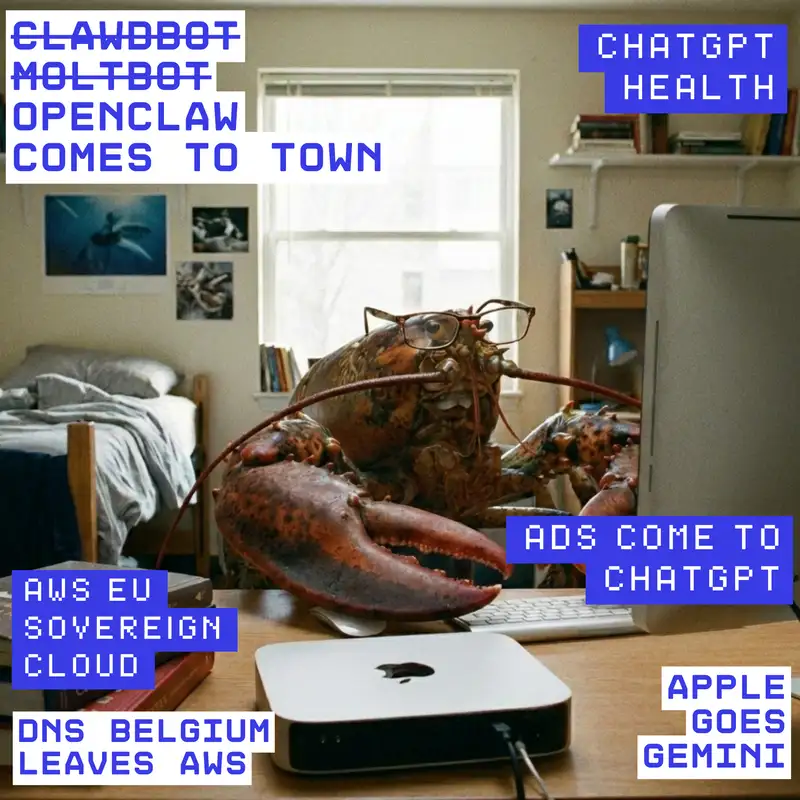
AWS EU Sovereign Cloud, DNS Belgium leaving AWS, and Moltbot arriving right as Apple picks Gemini
Hi,
Murilo:everyone. Welcome to the monkey patching podcast, where we go about all things DNS, ads, and more. My name is, and I'm joined as always by my friend, Bart. Hey, Bart.
Bart:Hey, How are you? I'm doing well. I'm doing well. It's been it's been a while.
Murilo:It has been a while, hasn't it? How come has how how how
Bart:I don't know. I guess life got a bit busy in the new year or something.
Murilo:Yeah. New year, new what?
Bart:The festivities pulled us out of our structure.
Murilo:It did.
Bart:It did. And then it got a bit busy. And then and then before you know it, it's January.
Murilo:Yeah. But it also gave us some time to reflect a bit as well. Right? Yeah. Yeah.
Murilo:We also Not that
Bart:there are any conclusions, but No conclusions. Yeah.
Murilo:But I think it starts with reflection. Right? It starts with the, like, navel gazing. Right? And so, yeah, maybe we've been we've been discussing a bit as well in between the the recordings, maybe about a new format.
Murilo:Right? And I think the the reflection came because we quite very much enjoy doing the pod, but also at the same time, we see that there's a lot of similar podcasts. Right? Even the tech podcast about tech news became AI news very quickly. Right?
Bart:That is true. That's true. Even though, like, we we can't I really complain either. Right? Like, we know if what is it?
Bart:7,000 subscribers on YouTube?
Murilo:Yeah. Let me check.
Bart:Yeah. A bit less than
Murilo:a year. 600.
Bart:We started in May, I want to say.
Murilo:Yeah. I did feel like we can't we can't complain too much.
Bart:But, yeah, I think we were, like, in the in the spirit of the New Year thinking a bit about what are our podcast resolutions. Right?
Murilo:Yeah. Yeah. And what can we do that maybe that's a bit of different angle. Right? Something that can be interesting for people.
Murilo:So, yeah, I think we've been toying with the idea of doing a bit more interviews. Right? Interviewing different people, maybe startups, maybe products, maybe different
Bart:But we're still a bit in the brainstorm phase, I guess. Right?
Murilo:We are. We are. We are. In that in any case, I think we we also discussed that we'll probably still do the new segment. Yep.
Murilo:Right? But maybe in a different cadence or something.
Bart:But if we go for the more frequent interviews, we might do the news, like, only monthly, like
Murilo:Yeah. Highlights of the month.
Bart:But all of these are just brain farts now. Right? Like, for the interviews, we're thinking, like, maybe it's interesting to have, like, both tech startups, but also tech investors like this combination could be interesting.
Murilo:Yeah.
Bart:Yeah. We
Murilo:need There's also have the newsletter, how this new letter comes in as well. Right? So there is some moving pieces and so, yeah, we have some reflection. So
Bart:Yeah. We need a few more dinners to stimulate the brainstorming.
Murilo:Exactly. Exactly. And, yeah, maybe also in the next month as well, I will be taking some some time off. I have a friend's wedding, so I will be well, February as well. Maybe we'll have a slightly different cadence, but it's a bit unrelated to this.
Bart:It's Bill's fault.
Murilo:Yeah. So I'm late on me. But what do we have for today, Bart? It's a bit of a, again, highlights on the past week.
Bart:Yeah. We have a few few highlights. Let me I'll kick it off. Kick us off. AWS is rolling out a European sovereign cloud run exclusively by a EU professional scope to keep sensitive data on the continent and out of reach of US regulators.
Bart:Amazon says the project, backed by a 7,800,000,000.0 investment, launches January 15 and tackles mounting privacy and jurisdiction anxieties.
Murilo:Yeah. So I think we I don't know if we talked about it before it was a real thing, but we have definitely followed the EU anxiety, quote, unquote, towards the reliance on American clouds. We also saw some outages from AWS. Like, even if everything is hosted in EU, if there is one service in The US that sometimes, like, a DNS something something. Right?
Murilo:And I have I remember hearing before that AWS was gonna basically, it's like EU flavored AWS. Right? So I guess, legally and maybe some some also practical differences. But, basically, it was like the same AWS services you know and love in the EU. And I I thought it was already a thing, but apparently, no.
Murilo:Like, this was also this was released in in January. So AWS officially launches the European sovereign cloud.
Bart:Think it has been in the making for a long time. Yeah.
Murilo:Yeah. Indeed. So what do you think of that? Because we do have some European clouds, OVH, I wanna say, and I think there was another one.
Bart:Well, what do I think of it? It's a bit of a tricky political thing. Right? I think we've seen, over the course of the last, year, a lot of hesitance to, rely on American suppliers even though sometimes we don't have good alternatives in the European Union. But like, the geopolitical tensions that we have and I think the the the lack of trust in the American system as it is today is, is forcing a lot of European institutions, to look at European players.
Murilo:Yeah. And would you say AWS is now a good European player, like a good alternative?
Bart:Well, what I what I do think is that we've seen accelerators under there are a few examples in Germany. So you've OVH indeed. You have, Skillways over the French, and that they've they've that they've been boosted a lot in the last year because of this. I think this is a response of AWS that fears to lose their big customers, which typically is big European government, customers, which do generate a lot of revenue for them. And this this is their, this is their way to say, ah, but we're not.
Bart:You can trust us. We're fully on European soil, but you but they basically get here. The customers that they get their encryption keys to their data. So even if someone within the AWS would want to exit, they can't because the customer has encryption keys. Yeah.
Bart:I think it sounds good on paper. Right? Think whether or not it's like, if there is ever a litigation from a US side that AWS can enter the data center in Europe, we don't know. Right? Like, it's still an American company.
Bart:The encryption keys, like, they of course, they help. Right? But it's, like, it's clearly like a reaction to a lack of trust.
Murilo:Yeah. For sure. But then, like, even in this, like, with the AWS European sovereign cloud, that would still be the the same, you think? What do you mean? Because I'm wondering, like, I mean, you mentioned, like, the the if the authorities, they go in and they want to
Bart:So what what I understand, but it's where my my very limited legal understanding of this, is that because it's a fully European entity
Murilo:Yeah.
Bart:Which in the end is still owned by AWS US, of course. But the way that they structured it is that that US parent, which is AWS in The States, they cannot technically access it. Like, even, like, the there's even no, like, emergency parts to do this. Yeah. They're not allowed to do that.
Bart:AWS outside of the EU also doesn't hold the encryption keys. Right? Like, it's really the customer that holds it. Yeah. So they make it very difficult.
Bart:But even, like, if by law by the current US law, they're not allowed to touch it, that doesn't mean that the law can't be litigated. Right?
Murilo:Yeah. True. True.
Bart:And I think there is very little trust in the in the current system.
Murilo:I agree.
Bart:Especially with a country that is constantly being mistaken for being Iceland.
Murilo:I will not take that bait today, Bart, but nice try. Nice try. But, yeah, indeed, people are not well, there's a lot of distrust, and and some people have already actually left AWS because of this, including DNS Belgium. So DNS Belgium's dot BE registry. DNS Belgium says it plans to move its domain registration systems off AWS aiming for a European cloud provider as sovereignty, climbs the agenda.
Murilo:Leaders cite geopolitical risk fearing US restrictions and expect the transition to start in 2027 and finish in the 2027 without disrupting DNS resolution. So this was in December 3. So it's before AWS announced the sovereign cloud, like, officially, let's say. Right? I think, again, we heard about it before.
Murilo:But, yeah, I think, again, it kinda paints the the picture here. Right? Like, I think they even mentioned at some point, although we're really satisfied with AWS as a technical partner, we do not want to risk finding ourselves in a situation where we have to take a swift and unprepared action. So, basically, they're saying, we don't have any reason to distrust AWS per se. They have been doing a good job, but the geopolitical tension has prompted us to be proactive and choose something where we can migrate in a timely manner and not have to deal with the consequences.
Bart:But I think the quote there is very it's a very sensible one. Like Yeah. If you're running something that needs to be very robust, like in this case, like a a registry. Right? Yeah.
Bart:Like a domain registry. Like you don't want, if you're in a situation where you don't have the trust that you can rely on this for the long term, then there might be something that pops up that that forces you to act in a matter of a couple of weeks, which is super difficult for a large extent and established company. Right? Yeah. So this is basically like a proactive move even though they're they're happy about about the the the service that they're getting.
Murilo:Exactly.
Bart:Yeah. This is which is a pity, and we've discussed this earlier. Like, this is just because, like, the the American brand has completely deteriorated. Deteriorating. Deteriorating.
Bart:Thank you very Yeah.
Murilo:Yeah. But I agree. Yeah. Like, again, another quote from the general manager of Dinesh Belgium. Geopolitical realities are forcing us to think more carefully about our infrastructure.
Murilo:So, again, I think it's very again
Bart:So I think if the geopolitical climate stays like this, like, you see these well, Dines Belgium is probably a relatively small organization. Right? But if this continues for the coming ten years, like, we will see all government agencies moving away. For sure. I think it's as simple as that, and they will not go to AWS Europe.
Bart:They will go to a European provider.
Murilo:For sure. No. I I also agree. I also agree with that. In that so maybe taking a different point of view because I was discussing this well, not this per se, but, like, this topic in broad terms with a friend.
Murilo:And he's he was saying that there are some benefits from this or there are some some upsides, right, that now we are investing more in being independent, so, like, more in European clouds or more in I just heard, I think, this morning there was a deal to to you and India as well for, like, there are different things that come out because we say, okay. Maybe we shouldn't rely so much on other countries. Right? We need to be a bit more self sufficient, and there's a bit of mobilization towards that. I mean, you can all you can only think about AI.
Murilo:Right? Because today, it really feels like it's US and China. And we talked with Charlotte as well about the AI factories and how they want to to encourage the use of AI and the large computers, GPUs, and all these things. Right? Do you how how do you see do you also do you also agree that this is a maybe in the long, long, long term, it can be good for Europe because it kinda wakes us up and forces us to be more proactive on these things?
Murilo:Or do you do you not agree with that at all?
Bart:No. I definitely agree. Like, this brings the incentives to build something new. Right? Something that is competitive.
Bart:And I think, like, let's let's be realistic If we ignore the Chinese players, there are only three major cloud providers. They're also they're all US. It's time to have some competition. So
Murilo:maybe yeah. I think
Bart:The the thing is, like, like, we've never really seen, like, this as competition. Like, the EU US has always been, like, the the law like, like, an extension of the EU. I think in a lot of people's minds, right, like, like, it's a loyal ally. There's no friction there.
Murilo:Yeah. I feel like and that's the thing. I mean, you can talk about this, but you can also talk about, I don't know, security and all these things. Right? Like, it was when we saw US as a reliable partner, it was easier to just lean on them.
Murilo:But I feel like when when that assumption gets challenged, then I think it also prompts you to to do something. Right?
Bart:So I just I think you see this example. It's a bit of a different setup, but in China with chip production as well. Like,
Murilo:they're Exactly.
Bart:The screws get get tightened, and they don't almost get no no chips exported to them anymore by by NVIDIA. And then what they do, like, they they set up their own production because you can't rely on your partner anymore. Yeah. And you still want to be you still want to have this service. You still want to have this capability.
Bart:And that's that's basically what we're seeing here with with cloud providers. Right? Yeah. Exactly. I fully agree.
Murilo:I fully agree. And I think we could also extrapolate to some other fields. So I'm also wondering if, yeah, like, long term, this is not gonna like, I wonder if in the long term, if this is not gonna hurt The US more than anything. Right? But, I mean, what is long
Bart:But it's Yeah.
Murilo:Yeah. Yeah. We'll see. We'll see. And what else do we have?
Murilo:What's next?
Bart:Moldbot. Until a day ago, it was Claudebot. So TechCrunch explains how Claudebot, now Moldbot, after an Anthropic dispute, went viral as a personal AI that actually does tasks like scheduling, messaging, and check ins, and why that matters now. Built by Austrian developer Peter Steinberger, it has 44,200 GitHub stars and jolted Cloudflare shares 14% pre market while prompting warnings about how to run such agents safely. But this news went went viral, I want to say, three or four days ago.
Bart:It's about Claude Bot, what's called originally. Very confusing. Claude, as in c l a w d bot. Claude, like a lobster claw. Yeah.
Bart:And Tropic, of course, contacted them and say, this is a bit of a breach of trademark. And then they did the mature thing, they simply, renamed it to also very aptly. What does a what does a, crap do? And when you go to the next visit, maltz. So now it is a Maltz bot.
Murilo:Yeah. But I'm also happy with this change, to be honest, because for the first thirty minutes that I was talking to someone, like, how did you see Cloudbot? And I was like, oh, Entropic? Like, no. Not Entropic.
Murilo:Cloudbot. And, like, the conversation was difficult because it really yeah. Phonetically, it's the same. But yeah. So what is what is Moldbot?
Murilo:So Moldbot,
Bart:you install on your, on wherever you want, basically, on your local device. Whether this your day to day thing or something you have on a server box, but you install it there. It's still a bit, I want to say it's a bit technical. You need to be a bit tech savvy still to set this up. But from the moment you have it set up, it's, it can do more or less everything that you do on your device, which, of course, like introduces a lot of security issues, but let's ignore them for the for the moment.
Bart:But you can like a simple example. Like, I give it access to my calendar, and then I can say every morning, at 06:30, send me an overview of how my day will look like. And then it will send this to me via well, in my case via WhatsApp. But you can send connect via a lot of different channels. Like, it has a lot of plugins, set up and ready to go.
Bart:You can say, you can let it answer emails for you. You can let it negotiate a price for whatever you're negotiating via email. You can let it go through your, hit the PRs comment on them. You can actually let it execute terminal code. So I could let it execute a cloud code command like these type of things.
Bart:Like, it's very, very, very flexible. Like, it's basically it's a bit like to me, it's a bit like what you could already do a lot of these things with Cloud Code Yeah. Because Cloud Code also has access to your full system, but it it comes with already a lot of different plugins out of the box, a bit more user friendly than that.
Murilo:Maybe a question. How is this what is the difference between Multipot and Claude Cowork? Oh,
Bart:then we need to introduce Claude Cowork. Yes. Claude Cowork is if you have the clot desktop version, you can go to clot co work and it's basically say a visual version of clot code. So you can say there, go through all these files, find all the addresses in there and make me a clean list in a CSV. I'd like to take, like these kind of things.
Bart:You can also let it interact with your browser.
Murilo:Yeah. Yeah. The way I I I saw I heard from Simon Willison is exactly what you said. Like, it's people were so Cloud Code is is a terminal thing, and developers started using for more things than just coding. And they kinda Cloud people and Topic people realize this, and they kinda created for maybe the less technical savvy.
Murilo:Right? So you have an app, but basically interacts with your computer the same way that Cloud Code would do via the terminal with the sub agents and all these things. It kinda it's it's it's now catered more as a general purpose or for the general population kind of thing. Right? But it still does a lot of things on your
Bart:I think a big difference with with this versus like Moldbot is that Moldbot also allows you to do a lot of more proactive stuff or reacting to events. You could say whenever this message comes in, do this. Or every every morning at that time, do this for me or like it's or like regularly check-in with me on this or or like with this. Like if you if you haven't heard from this person in x x time and then send them a reminder because of waiting for this feedback on this RFP. Like, you can do like, these kind of things, like, you can't do with cold work with cold work.
Bart:Right? Like, well, technically, maybe you can. You can let them build scripts and stuff, but there's much more work.
Murilo:Yeah. I see. It's like it's more custom. Need to Yeah. And this one is more, like, off the box.
Murilo:Have you tried it?
Bart:Moldbot, we could actually like, we do a lot of research on finding articles for her or podcast. I think if we can actually, like, through the week, let it research for us True. And, like, come with the most, like, newsworthy stuff. I think it would be a good try.
Murilo:Yeah. Indeed. I'm also wondering if we could use Moldbot to prepare maybe the the the show notes or something. I don't know. I feel like it could be maybe a question.
Murilo:This is I I imagine this is not the first one to do something like this. Right? Like, the ideas are there. Like, coworker's there. Do you think there's something about MoldPods that made it go viral specifically?
Murilo:Like, maybe it's the plug ins or maybe it's just because it works well?
Bart:I think it's just because it works well. Like, the creator by now are multiple people behind this, but the creator, like, they they literally made, like, their own AI agent that they use for themselves, their personal assistant, and and let it evolve over time and saw what worked well, what didn't work well, but also what became easier when models evolved and then turned that into Moldbot. Yeah, it's cool. It's really from my not built from let's build this, but like
Murilo:Like, we're using it.
Bart:Like, if I'm trying something like this, like, have a prototype that I've had for the last year, and I've been improving over time.
Murilo:And it is free, right? Like, it's open source. I can just install with Bash.
Bart:I think for now it's completely open source.
Murilo:Yeah. Yeah. Very cool. Have you have you tried MoldPot at all, or have you seen the demo or have you?
Bart:Well, I actually installed it yesterday evening, and I played about two artists this morning. So, yeah, it sends me messages now over WhatsApp. It's called Jeeves, my AI assistant. Yeah. So it
Murilo:sends you messages to your WhatsApp? Yeah. Interesting.
Bart:That's actually like, you're looking good, Bart.
Murilo:These kind of things. Don't listen to them. You're beautiful. That'd be cool. Maybe you should do, like, a little demo or something as how to set it up or something.
Murilo:It could be it could be interesting.
Bart:Yeah. That's be cool. Yeah.
Murilo:Yeah. Because like I said, it's still a bit still a
Bart:bit techy. Right? Like, it's you need to be a bit tech savvy to set it up. It's not like it's not yet not yet for everyone.
Murilo:But, honestly, for me, this is kind of I get very excited about this because I do think I'm techie. Start there. But, also, I feel like there are lot of tasks on my day to day job that are not techie. Right? Like, things like, I'm organizing this and send a message to every presenter to check this.
Murilo:Like, for example, we organize the Python user group. Right? We wanna send a message to all the speakers to make sure that they're there. Yeah. Thanks.
Murilo:Like, you know, like, these things can really I mean, and also these are things that I forget. Right? So I think it's good to have another another layer there. So yeah. Very, very cool.
Murilo:Excited about this. I'll definitely give it a try, but maybe we should also do a little tour three sixty on MoldPot. What else do we have? And this is from a few weeks, but a new ChatGPT Health Mode is being pitched as safer, more structured way to use AI for health and wellness, including grounding answers in your own connected data. The tension is immediate.
Murilo:The more personalized it gets, the more conversation shifts from general advice to something that feels like care without actually being medical care. Oh, this is in Portuguese. One second. And so CHAJPTI Health. Right?
Murilo:The way that they so I saw some I read the the announcement here. Right? And I also saw the videos. I think the way that they position, the way they introduced this, it makes a lot of sense, to be honest. Right?
Murilo:They're basically saying people used people are already using CHEGPT to make sense of the medical world, right, which is very jargonful. So now they just want to be more responsible in a way and have, like, a sandbox environment for health things and some things that are more like, they did say that this was built with next to health care providers, or I think they didn't say or physicians they mentioned or something. And, also, you can also enrich the the conversation history with health data, mental health, whatever. Right? I saw I don't remember where.
Murilo:I saw maybe an article that they the the the responsible or the person that announced this, they purposely didn't mention mental health, or they were a bit vague about it. And journalists explicitly asked them on this. Like, what about mental health? And they just gave an answer like, well, mental health is part of so we're definitely working on this. I have mixed feelings about this, to be honest.
Murilo:How do you feel about CHGPT health parts? And maybe for people that listen that don't know, you do have a a background in health care. No? Like
Bart:Out of my career at university hospital. Well, I don't think that that really halts anything to my heart, sir.
Murilo:I don't know. I feel like it does because I feel like there are a few things that if you reach IGBT, like and it says some things, you have more background to say, okay. This is not true. Or maybe it's never a 100% of the cases, or it's never as sure thing. You know?
Murilo:And I feel like for a lot of people in the general population, they don't have that.
Bart:I'll try to give you an answer. Okay. So I think the I think the smart thing to say is here is that you need to, always, go with the problems with your doctor. Right? I think the reality is as well that the health care system, depending on where you are, but generally is very busy.
Bart:Sometimes hard to get an appointment, to get to talk to a specialist. So this is also just hard to diagnose something like, know, pain here. Yeah. Let's maybe wait a few weeks. Right?
Bart:Like, it's a it's a bit vague. Yeah. I think the other maybe just like the other reality to that is as well, like, people will search themselves. Like, before ChatGPT, this this wasn't about WebMD. After WebMD, this became ChatGPT.
Bart:I think the strong thing of ChatGPT held is that the objective at least is to basically pull in all your medical files to really have a reference like who is who is actually this person that I have in front of me and is it like and it will probably like, increase the perform like, the quality of the answers. Yeah. For sure. Instead of just having, like, I have this pain and just, getting all possible answers for a specific pain and people getting crazy worries.
Murilo:Yeah, for sure. Yeah. It's like there's the joke, Like whenever you research your symptoms, the third option is always like cancer or something, you know, it's it's like Yeah.
Bart:Yeah. That's that's what it is. And people will search for the symptoms, Like even if it's on chest X-ray PD or as a WebMD or whatever it is. So, yeah, I'm I I think assuming that people will use something like ChatGPT to search for symptoms anyway, I think it's good if you have a functionality to pull in all your actual medical data to improve that the quality of that of that of that chat, basically.
Murilo:Yeah. And I agree with you. I think for me, the other side, though, is, like, this shouldn't like, this I mean, I feel like when you when you read something on a website and then you saw, like, oh, yeah. It could be this, this, and this, like, because you read it. It never really felt like medical advice.
Murilo:Right? But I feel like when you talk to a bot like Chai GPT, it is easier to see that as medical advice. I'm thinking more for, like, the general population. Right? They see this as, oh, yeah.
Murilo:This is what it is. And there are some cases of people that they follow advice from from from AI bots that were actually very dangerous to your health. Right? So I think
Bart:Well, what you hope is something like that is not next to next to pulling in your files is that it also, like, is trained or at least instructed to use verified sources to corroborate stuff. Right? Right. That's what you would hope.
Murilo:I would also hope that there's a disclaimer. Right? Like, don't just verify with your doctor and do any things. Right? So yeah.
Bart:Well, yeah. And at the same time, you have this news. It's not specifically about JetGPT, but it was news two days ago. Someone had researched two usage in OpenAI, like web searches to validate stuff, and JetGPT was using Wrokopedia to find stuff like facts about to verify facts about Iran. Like, I think, like, I mean, that doesn't really, like, up the trust.
Bart:Right? Yeah. Exactly. Let's hope that they that they have verified sources in at GPT Health. Yeah.
Bart:But, yeah, there's there's there's a lot of what ifs to this. Right?
Murilo:And maybe one one thing that I also think is a I do think it's a good use case and lower risk, let's say, is like you mentioned it's hard to get appointments. But not only that, sometimes also, like, you you wait three months for an appointment with a doctor, and then you have, like, a window of one hour maximum. Right? Because the doctor also have other patients.
Bart:One hour is longer?
Murilo:Yeah. One hour is long, but that's what I'm saying, like, maximum maximum. Right?
Bart:Yeah. Yeah. If you're very lurky.
Murilo:Yeah. But I feel like get like, sometimes doing your homework yourself, you know, you get the blood results and, like, okay. Help me understand this. Like, let me and, like, you're already kind of speeding up a bit the process so you don't have to like, you know, because sometimes the doctor doesn't have that much time to really explain everything to you and ask all your follow-up questions. And then when you come to the doctor's appointment to be a bit more ready, like, okay.
Murilo:I talked to CHPT. These are the things that I understood based on my history. What do you think? Right? I do feel like that can be a very nice use case.
Murilo:Right? Because I think it's you still have the I mean, you still should believe the doctor first and foremost. Right? But it still provides you with a more understandable not educational necessarily, but, like, just something that you can easily digest. Right?
Murilo:You can talk to your GP, like, hey. Explain this like I'm five. Right? Or it's like, I don't really get this. You know?
Murilo:I feel like there's a lot of tools there, and I do think that's that could be a very nice use case. Yeah. I agree with that. Maybe related to this, Claude also they announced something similar. Claude, advancing Claude in health care and life sciences.
Murilo:So he's also have a so this is also January a few weeks ago. I think it was actually shortly after. Yeah, like, see, CHECH PT was on January 7, and this was on January 11. So one right after the other. And very similar, you can also connect to your health devices, Apple Health and whatnot.
Murilo:But the it was less focused on, like, from the announcement that I read. They did seem less as they didn't specify as much on, like, giving advice or, like, all these different things. They did talk more about digesting the results and connecting to your data and all these different things. So I feel like they definitely took a more, how can I say, a different approach? Right?
Murilo:I feel like it's it's it's less for for people to say, hey. If you're if you're wondering what's happening with you, I can help you. It was more about, like, if you want to connect your health data and you want me to process data for you, I'm here. So I feel like it was a more cautious approach, but both JGPT and Claude now offer something like this, which, again, like you said, people have been doing this before the AI. They'll keep doing, so I don't think it's
Bart:And also interesting, limits sideways related through academia is that OpenAI also yesterday announced I forgot the exact name. Let me quickly check it out. It's called, Prism, which is a collaborative suite, for researchers to, basically research and build papers on research.
Murilo:So it's a so it's a platform. It's not just a
Bart:Yeah. Exactly. Yeah. So, of course, not necessarily health health care related, but it's academics related. Yeah.
Bart:So, yeah, I would hope so this is also an example where you see, like, people are gonna use something like Chateapiti anyway to research and write papers. Maybe if OpenAI built something like this, like they have really strong guardrails in place to make sure that there is no hallucination, etcetera, etcetera. Like if someone is best placed to to avoid hallucination, it's the it's the it's the it's the provider of the model, of course.
Murilo:Yeah. For sure.
Bart:So there's reason to be optimistic if we ignore the Dracopedia stuff of a few days ago.
Murilo:Yeah. But I mean, again, in any case, and I I'll keep saying this that whoever produces an output should still be responsible for it. Right? And I think you should always know that AI is a tool. You can hallucinate.
Murilo:You can do this. You can do that. Yeah. The models are getting better, but you you should never be able to get to a point where you say, ah, blame blame JGPT because of this. Right?
Murilo:Like, I think there's some exceptions, of course, like everything in life. But
Bart:No. That that I fully agree. You're you're responsible what you what you what you put in there. Right?
Murilo:Exactly.
Bart:But at some you would hope that something like HPD, especially if it's built to do research, that if you find information or effect that you don't need to validate whether or not it even exists Yeah. That we get to that stage. Right?
Murilo:For sure.
Bart:For sure. You're still you're still responsible for this, but but say if you search something now on Google Scholar, at least it exists. Right?
Murilo:Yeah. I
Bart:hope we can go to that step at some point.
Murilo:Yeah. And I think, again, the way I use AI, right, there are things that are expensive mistakes and cheap mistakes. Right? If it's a cheap mistake, then maybe I'll just go on a I'll be trustworthy towards. If it's something that is an expensive mistake, then I'll do my homework.
Murilo:Right? And I'll check things. So I think there's also a bit of that, which is like another layer of thinking for people. Right? And I do think it's nice to see this well, like you said, Prism, I think it's very clever from CHAGPT as well because we have seen as well that researchers were using AI.
Murilo:Right? We saw papers that were published with the classic Chad GPT. Hi. Here's information on x, or this is how to write a conclusion, or do you want me to expand on this? So, yeah, again, people are already there.
Murilo:Right? So let's let's build a product where people are already and not try to build a product and then get the people in. Exactly. And so cool. What's next?
Bart:Let me see which one. Oh, sorry. Yeah. OpenAI outlines how it will keep ChitGPT's advice independent as it pilots ads and rolls out the $8 per month go tier to all 171 support countries. Ads will sit below answers, be clearly labeled, and switchable to off with no data shared with sponsored, the company vows.
Bart:So ads are coming to JCPT Yes. On the go tier at least.
Murilo:And the go and the free tier. Yeah. So I read this as well, the ads principle. Right? And I think we we did discuss because there were rumors their ads were coming, and I think they kinda addressed all all the rumor or all the concerns, let's say.
Murilo:Right? So they said, okay. But the answers will not influence CHPPT. Right? You can like, we're not gonna share your data with the ad providers, like the conversations.
Murilo:Right? You can personalize ads or not. Yeah. You can like, with long term value, we do not optimize your time spent in Chechnya PT, so we don't want you to linger there to see more ads. We want to trust the user experience.
Murilo:And also one thing that I thought was interesting is like, it needs to like, they're not gonna just take any ads. Right? There's needs to be a mission mission alignment. This is how we will
Bart:look at this just forced to say that because they still are this
Murilo:Nonprofit or something?
Bart:Yeah. Yeah. But it's also interesting their statement there if you go up a little bit is, today we're talking about the free and the go tier, right, where there will be ads. But they're saying, if you go back down a little bit, the ads principles well, they're basically saying that there will always be a paid tier account. I don't I don't see it right now.
Bart:There will always be a a paid tier that it's ad free, but I'm not saying which one it is. That is true. Today, that is from the pro tier and up. Maybe in the future, it will only be the max tier.
Murilo:That is true. That is true. That's true. It's very sneaky. I also think that they're saying this now, and these are ad principles, but also these things could evolve over time.
Murilo:Yeah. Of course. Right? So I think it's nice to say, and I think, again, if you're doing ads, I think that's the correct thing to say, but it could change in the future. But they also gave some more for example, this is an example how it would look like.
Murilo:Right? So you have the conversation. You have something at the bottom that clearly shows that it's an ad. And then, actually, you can like, once you click on the ad, like, if you like, in the example here is about, I guess, a trip, and then it has an ad on winery or something. And you can click on the ad and chat with that.
Murilo:So as to say, like, okay. What do you recommend? Like, okay. What is this about? What's the price range of this?
Murilo:And I guess you could also book. Right? I think they've been with the commerce things, they also been building up to that. So, again, I feel like of all the ways that this could have gone, I think this is one of the better ways, right, like, terms of of ads and all these things. I think this is in the bringing US and everywhere to HCPT is available.
Murilo:Yeah. So a lot of a lot of different places. What do you think I mean, also, I heard, and I I don't it's not here, but I think I heard somewhere that just from ads, they expect to have, like, billion revenue.
Bart:It's a lot
Murilo:of free users. Exactly. A lot of a lot of free users. What do you make of this?
Bart:Yeah. I think at this point, no one is really surprised. Right? I think I would have a problem with it if it's I'm on the pro tier. I would have a problem with it in the pro tier and getting ads.
Bart:I think with the free tier, you're like, if you're not paying for the product, you're the product. Right?
Murilo:Yeah. Yeah.
Bart:Yeah. They're you to click ads or they're expecting you to use your data in in whatever way. The goateeer is a bit in between that. Yeah. Think we were all waiting for this to happen and no one is really excited about it.
Bart:But I think also there are a few there are a few people that are very, very vocal about this being anti, but I think the large majority of free tier users, they won't care. Yeah. And they're also very used to it. Like, if you're on on on Google, you search for something like the I mean, half of the pages ads. It's promoted content.
Bart:Sure. And I'm and this is all a bit much. But at the same time, ads bring us a lot, like, ignoring whether it's on the Cheshire Petite platform. Ads allow people to start a company. And if I start a company today and I pay for a little bit of ads, then I'll be known in the in the whole European Union a month from now.
Bart:I mean, ads do a lot for the economy. So I'm not necessarily against ads, but I think it's, sometimes we hope to be, to have a bit of peace and quiet. Yeah. Yeah. Peace and quiet is taken away by, by, too much ads.
Murilo:And I also think that the happy, happy, happy story about ads is that you discover things that you wouldn't normally discover yourself. Right? So it's, like, recommendations.
Bart:Well, exactly. The that's the other side of it. Yeah.
Murilo:But I'm also wondering if this if if you I don't know if I don't and, again, maybe I wanna hear your opinion on this, but do you think this also put in context a bit the pressure financial pressure from investors on CHIPTY on OpenAI, sorry, because they we did hear about well, first, Sam Altman, and he's I don't know if I don't wanna say showman, but he he is you know, like, he he makes bold statements at times. He did say that ads was gonna be a last resort, then we hear about code orange, then we hear about code red, and then we hear about, like, they're losing market share to Gemini. And now they're doing ads, which I I do think it would happen. I do think it is the right move. Right?
Murilo:Like, you're trying to to make a profit. It still feels like aside from CHJPT, they're still trying to see how to convert all these things to to profit. Right? And ads is the most trusted, easier path forward, right, to to make money from these free users. Right?
Murilo:Like, it's think it would be much, much, much, much, much harder to convert free users to paying users.
Bart:Well, especially at their scale. Right? Exactly. Right. Well, what I think you should not ignore is that they are very much making a consumer facing product.
Bart:Right? Like, like, Entropic is much more enterprise developer focused. It's a
Murilo:different type different of
Bart:way to to monetize this. Yeah. I think and like you're saying, like, it's very hard to convert all those paying customers to to I think it's not doable. Right?
Murilo:Exactly. Yeah. I mean and that's the thing. Was thinking of, like, other things. I mean, they're trying different things for sure.
Bart:And and and I think ads is also, like, it's a bit vague because it's just a simple ad to that that you're saying, but you also have, like, I would like to do a chat GPT where this and this product across multiple multiple providers get together provider that can get it to me in two days with a good price, with a good with good reviews, and just, just order for me. Like, these type of things, I would be very happy if it's possible, and they can they probably get, like, a percentage of the sale. Yeah. Yeah. And it's also, like, sort of sort of promoted content, I guess, because, like, these partners need to need to interact with their ecosystem.
Murilo:Yeah. It's true. Or at
Bart:least connect with ecosystem.
Murilo:Yeah. I'm also ChatGPT, again, OpenAI, they their product is ChatGPT. Right? And I think it was free ad free until now. But they're also trying a lot of different things.
Murilo:Right? Like, they they mentioned, like, the hardware thing. You mentioned Prism. You mentioned health. You mentioned I don't know.
Murilo:There's a lot of different angles that they're trying to explore, which I guess is not bad. Right? Like, you're trying to see where where your niche is, your your paying niche niche is. I think for Entropic, it's more clear. For Gemini or Google, right, you have the whole workspace.
Murilo:You have a lot of different things that Gemini can rely on. And I think JHPS is just kinda trying to find their place even though being a generalist in this case, maybe it's not that bad. Right? I mean, now if you have count on ads and you count the revenue from ads, I think you're gonna yeah. Like, you're gonna definitely gonna make a lot of money there.
Murilo:I would imagine.
Bart:Yeah. And it's also, like, calling it a generalist, but are also, like, way bigger than any other player. Like, the True. The evaluation is twice as big as as Entropics, for example. Like, I mean, it's it's to be expected that they do more, rightly, they they have the scale to theoretically put it off like an
Murilo:Sure.
Bart:I agree that there's less, like, looking from afar. There's less focus, but Yeah. They're also way bigger.
Murilo:Yeah. And I did mention I won't before. Right? They're losing market share, which has been reported, but still, like, they're still the biggest by by quite a big margin. Right?
Murilo:So Yeah.
Bart:Yeah. Just to
Murilo:put in perspective what I said before. And what is next? Is it my turn?
Bart:Think so. Yes. The last one.
Murilo:The last one for today. Yeah. So routers reports, Apple will use Google's Gemini models to revamp Siri, a major vote of confidence that reshapes AI stack on billions of devices. The twist is what's means for OpenAI's role in Apple platforms. Does ChatGPT stay bolt on for, quote, unquote, complex queries while Gemini becomes the default intelligence layers?
Murilo:So, yeah, basically, the the story here, as I understand it, is that Google will start using Google Gemini for Siri, which a lot of different questions that come up. Right? So first, they they did have a partnership with OpenAI, but it wasn't like, I as I understand, like, Siri was not gonna be powered by ChatGPT. But, like, if you had queries, it could actually route the questions to ChargePT. So if you ask Siri something, say, hey.
Bart:It's possible now. Yeah. In in Apple Intelligence, you can set up your your OpenAI account.
Murilo:So it's just as, like, Apple Intelligence, like, the Siri will be OpenAI.
Bart:No. In Apple intelligence, you can set these, like, your your OpenAI account. And then for more complex stuff, like, you can use that. But by default, you use Siri.
Murilo:Okay. And now what I understand from this is that Siri will be a layer on top of Gemini.
Bart:Yeah. I'm not not sure what to say about this. Like, I have the feeling where every every quarter we get news that Siri is gonna be revamped, and it never happened.
Murilo:But now it seems like they're saying, I'm gonna stop trying. Like, Appointell, I just failed. Siri's still bad. I'm just gonna let Gemini take care of this. That's so that's all that's the other question.
Murilo:Right? So there's the two. What happens with the partnership with OpenAI, and does that mean that Apple is actually admitting, quote, unquote, or owning that they cannot build Appointelligence?
Bart:Like I say, it's very hard for me to reason about this. Like, this this this is is a discussion that comes back every quarter, and we were thinking the same with OpenAI that we're gonna get more access. Like, it's it's still shitty. Yeah. There is some Apple intelligence, but it's hard to use.
Bart:It's not user friendly. Siri still doesn't understand me when I'm in the car. Let's let's let's hope it's it brings a bit of AI maturity to Siri. I'll be I'll wait as and want to see it first.
Murilo:Okay. So you're cautiously optimistic?
Bart:No. I'm very neutral. I lost my opt optimism on Apple's AI capabilities.
Murilo:Okay. Okay.
Bart:We'll see.
Murilo:Well, I I thought if anything else, like, it is a interesting turn of events. Right? Like, I would imagine that Apple would grow their partnership with OpenAI, but they went another route. One thing also they said here that I thought was a bit interesting, after careful evaluation, Apple determined that Google's AI technology provides the most capable foundation for Apple foundation models. So, again, kinda saying like
Bart:From a partnership's point of view, I think this makes more sense on OpenAI in the sense that Apple is already a huge partner to Google, and they use Google as a default search engine, which generates a lot a lot of revenue for both Apple and Google. So this is a bit of the, a other direction in the partnership. Becomes a bit more two sided, which, of course, like, strengthens overall partnership. While you at the same point, you don't really have this bidirectional thing with OpenAI.
Murilo:Yeah.
Bart:So just from looking historically at their at the way that they've worked together, this this makes more sense. This is a known partner. This is trustworthy. This One thing they also mentioned Right?
Murilo:Yeah. Well, yeah. I think when you think like that, yes. I think it's more surprising because they had a deal with OpenAI first. Right?
Murilo:I think if you hadn't if they didn't have the deal with OpenAI and they say we're going with Google and you really think about it, it's like, yeah. It makes sense.
Bart:Yeah. Yeah.
Murilo:They also mentioned, like, technology already drives much of Samsung's Galaxy AI. Do you think that also plays a role? Like, they already are like, the Android devices. Right? A lot of times, like, it's like the, hey, Google.
Murilo:Do you think that expertise or that niche plays a role into this or not really? Because I mean, they mentioned it here, but I I wouldn't have said that it's that relevant, to be honest.
Bart:Maybe just means that they have a lot of experience interacting with edge ecosystem.
Murilo:Yeah. Maybe.
Bart:Because I bet that's basically what you're doing. Right? Like, your your instrument like, you're using an Alamto instruments, like a hardware device. Yeah. And it's in the end, it's still Apple that need to label it.
Bart:But we've seen that the the the models of Google and especially Gemini three flash, like, is very good at at these things around two two usage. And so yeah. So we'll see. We'll see. It will still depend on, whether or not Apple can execute.
Murilo:Yeah. But I also feel like this sounded to me like they're kinda saying we cannot really execute, so we're gonna lean more on someone else that we believe can execute, which also is a bit of a first for Apple. Right? Even when they announced the partnership with JGPT, I remember people discussing that Apple was very known to build everything from themselves, and it's a very elegant product. And they wait like, they waited a long time because they wanted to be polished before they go out to the market.
Murilo:And then the Che GPT announcement was also a way to kinda say if this is if it is because of ChatGPT's answers is not Apple's answers. Right? So also the bit of brand protection, but I Apple Intelligence also failed.
Bart:But it's also, like like, there's one way to look at it, but that it's that's only is true if you look at an LLM as just not a piece of software. Like, a good LLM these days is very hard to build. Right? Like, if you look at at the chips that Apple uses, they have their own chips, but in the end, they are being produced probably by a lot of them by TSMC. So they don't have their own foundries.
Bart:They have their own specs on how to produce them, but it's in the end that they're they're relying on foundries to to actually do it. Yeah. And you could look a bit at this partnership the same way. Right? The the the LLM is being provided by a by a provider like Google and but everything around that and wrapped around that to actually use that in their product is built by Apple.
Bart:That's like a very good user experience. That's one way to look at it. Don't think it's fair to say, like, because you're not using an LLM, it's you don't own it. Like, because it's an LLM is, like, we've seen the investments that were required for for OpenAI and Entropic and the big players to have something that is that is very performant. Right?
Murilo:Yeah. And I think for I mean, I think in the case of Google, we're talking very highly of Gemini right now. But if you asked us, like, a year ago or maybe a bit more, like, remember Bard when it was announced and, like, or Google when Google introduced AI Answers. Damn. I, like, I feel like the I feel think of the investment they probably took to really get to where they are.
Murilo:It was a lot of error, a lot of trial, and I and I think so I I think it just speaks to to what you're saying. Right? It's not it's not trivial.
Bart:Maybe this will become easier, like, five years from now. Yesterday, Kimi k 2.5 was released, Better in tool usage than all the other big ones. Yeah. So maybe it will become easier to build these things. Right?
Bart:But I think don't take this now.
Murilo:Indeed. Yeah. I agree. I agree. And I think I agree.
Murilo:I wonder if at one point there would be no first mover's advantage. Right? Like, if at one point things are gonna be, like, saturate, and I wonder. Not sure. Maybe one last question before we call it a pod.
Murilo:Do you have you used open open source models or, like, nonpropriate like, my open source models? Like, I'm thinking more the Kimi or the more geeky, like the Chinese models. Right? Have you ever used those for coding or not at all?
Bart:It's been a while.
Murilo:But you have done it in the past?
Bart:Yeah. Yeah. But it's when I used to open router a lot. But I've been on ClotCode for, I want to say, the last six months.
Murilo:Yeah. I was actually playing a bit, and maybe we can talk about another day. I played a bit with bring your own key to to Claude. And one of the things you need to do, like, if you want to use even if you notice Gemini with Claude code. Right?
Murilo:And, like, I need the API route. I also heard from on I saw on LinkedIn someone saying that Minimax 2.1 is good for coding. It has the same API as Cloud Code, so you can just replace it. But I think there's not like Olama, I saw as well that you can actually run models locally, and it still exposes the same API that Cloud Code expects. So you should be able to also use local models.
Murilo:I talked to someone that tried it, and it didn't work well because they I mean, it's locally. Right? Like, the models are a bit shitty. So I'm also a bit curious on that. Right?
Murilo:Like I said, how this how this works and how Cloud Code starts becoming less Cloud and more like
Bart:a Yeah. Great. That's something that we maybe can deep dive in.
Murilo:I think so. I think I mean, at least that's something that interests me. Again, if anyone's listening that says, not interested, you can let me know. If you say, yeah. I'm very interested.
Murilo:Let us know as well, and we'll definitely bump the priority on these things. But I think that's it for today. Any last words of wisdom you wanna share, Bart?
Bart:Make sure you trust your partners.
Murilo:Like like your your spouse? Or what do you mean?
Bart:Your, well, I'm hey. It's a bit awkward. I was referring to the first article that we were discussing.
Murilo:The first article? I forgot already.
Bart:It's about the
Murilo:the AWS. A serving cloud. Yeah. Okay. That's true.
Bart:That's let's make sure you trust your tools.
Murilo:Okay. Trust your tools.
Bart:Maybe also relevant for Moldbot. Right? Yeah. That's true.
Murilo:That's true. Let's make sure.
Bart:What I tried just now on Moldbot? I've asked it to send you every morning, 07:00, a short playful compliment.
Murilo:I saw that you sent me one. Marillo, you're abs
Bart:you're No. I didn't. I didn't. Jeeves sent you one. Okay.
Murilo:That's the
Bart:name of my cloth mod.
Murilo:Marillo, you're absolutely techie, Jeeves.
Bart:Yeah. You were saying on the pod, like, a bit, like, hasn't it? Yeah. I think I'm techie. So I
Murilo:think just Ah, jeez. I'm blushing.
Bart:So now every morning, you will get receive a a compliment.
Murilo:But how does it so Jeeves sends you via your your phone number on WhatsApp, I guess.
Bart:Well, that's how it's that's the easiest setup. Yeah.
Murilo:Yeah. Because I know that, like, I I have set up, like, a little bot thingy, but it's it's it's a bit it's a bit cumbersome. It's not
Bart:On WhatsApp?
Murilo:Yeah. With WhatsApp, the setup.
Bart:What's the what's the business side? That's easy.
Murilo:You need to have a bot it's a business, and then you like, if you if you wanna have there's a demo, you have to
Bart:Telegram is super easy to do this.
Murilo:Yeah. I was actually thinking maybe we should switch to Telegram, and we can automate the the show notes as well. You know? Maybe we could do it.
Bart:So yeah. So I think when Hotbots gets video generation, like, this this will just be Jifs.
Murilo:Exactly. I think it's just we're just collecting all the paychecks from all the monies we get from the pod. Exactly.
Bart:I think.
Murilo:Yeah. And so if so if Jifs talks to you on WhatsApp, how does it talk to you actually?
Bart:Like, via my own name. So it
Murilo:just sends yourself a message. Yeah. Exactly. Yeah. Interesting.
Murilo:Interesting. Actually, yeah. Yeah. It's a side topic, but maybe I'll I'll ask after we off off recording. It's not that interesting.
Murilo:Bart, thanks a lot. Yeah. I'll see you next week.
Bart:Ciao. Ciao. Next week.
Creators and Guests